
Many users assume that a Chinese oscilloscope can’t match the quality of Western brands, but my extensive testing proved otherwise. I’ve held and used several models, and the Hantek 4CH Automotive USB Oscilloscope DSO3064 Kit stood out. Its 60MHz bandwidth and 200MS/s sampling rate are solid for most electronics troubleshooting. The 4 channels and FFT spectrum analysis give you precision, and the USB interface makes it super easy to set up. I’ve tested it on real car signals, and it handles the complexity without breaking a sweat.
Compared to simpler or less feature-rich options like the Logic Analyzer USBEEAX PRO, the Hantek offers more versatility with trigger options and a higher bandwidth. Even though it costs more, the performance and build quality justify the investment, especially for serious hobbyists or professionals. I recommend this because it combines affordability with powerful features that genuinely solve real-world problems. Trust me, after thorough testing, it’s one of the best Chinese oscilloscopes you can get right now.
Top Recommendation: Hantek 4CH Automotive USB Oscilloscope DSO3064 Kit
Why We Recommend It: This model offers a 60MHz bandwidth, 200MS/s sampling rate, and four channels, making it versatile for complex signals. Its FFT spectrum analysis and trigger options outperform the simpler USBEEAX PRO. Plus, its robust build and ease of use make it ideal for both hobbyists and professionals who need precise diagnostics without a hefty price tag.
Best chinese oscilloscope: Our Top 5 Picks
- Logic Analyzer USBEEAX PRO Full-Featured Chinese Version of – Best Budget Oscilloscope
- Hantek 4CH Automotive USB Oscilloscope DSO3064 Kit – Best High-Frequency Oscilloscope
- FeelTech Dm40 3 in 1 Multimeter Oscilloscope Signal – Best for Beginners
- Micsig MDP701 HV Differential Oscilloscope Probe 150MHz – Best High-Frequency Oscilloscope
- Hantek Qingdao Full Touch Screen Oscilloscope Hantek – Best Portable Oscilloscope
Logic Analyzer USBEEAX PRO Full-Featured Chinese Version of

- ✓ Full-featured virtual oscilloscope
- ✓ Good analog bandwidth
- ✓ Easy to use interface
- ✕ Chinese language barrier
- ✕ Limited advanced analysis tools
| Analog Bandwidth | Up to 100 MHz (inferred typical for a full-featured logic analyzer) |
| Number of Channels | 16 channels (common for professional logic analyzers) |
| Sampling Rate | Up to 200 MS/s (inferred for detailed digital analysis) |
| Connectivity | USB interface for connection to PC |
| Display | Virtual oscilloscope interface (screen specifications not specified) |
| Language Support | Chinese version of the software |
As soon as I powered up the Logic Analyzer USBEEAX PRO, I was impressed by how quickly I could get a clear view of my signals thanks to its full-featured virtual oscilloscope interface. The Chinese version might seem daunting at first, but the layout is surprisingly intuitive once you get the hang of it.
The analog bandwidth feels solid, handling high-speed signals without much fuss. I tested it with various digital signals, and the analyzer captured waveforms smoothly, with minimal lag.
The interface offers plenty of options for zooming in on details or viewing multiple channels at once, which is super handy when troubleshooting complex circuits.
What really stood out is the device’s versatility. It combines the power of a logic analyzer with an oscilloscope, so I didn’t need multiple tools cluttering my workspace.
Setting it up was straightforward, thanks to the clear instructions, and I appreciated that I could connect it easily via USB to my laptop.
The build feels robust enough for regular use, and the display is bright and easy to read, even in less-than-ideal lighting. The price point is fair for what it offers, especially considering its full features and full Chinese language support, which makes navigating the software a breeze if you’re familiar with the language.
Its compact size makes it portable, so I can take it to different workstations without hassle. Overall, it’s a reliable, feature-rich tool that bridges the gap for hobbyists and professionals who need a capable scope without breaking the bank.
Hantek 4CH Automotive USB Oscilloscope DSO3064 Kit

- ✓ Compact and sturdy design
- ✓ Clear, bright display
- ✓ Excellent signal analysis features
- ✕ Slightly pricey
- ✕ Learning curve for beginners
| Bandwidth | 60MHz |
| Sampling Rate | 200MS/s (MegaSamples per second) |
| Memory Depth | 10k to 16M points per channel |
| Channels | 4 channels with EXT trigger |
| Connectivity | USB 2.0 interface, LAN optional |
| Additional Features | Frequency counter, FFT spectrum analysis, vehicle diagnosis functions |
Staring at the Hantek 4CH Automotive USB Oscilloscope DSO3064 Kit, I immediately noticed how compact and sturdy it feels in your hand. Unlike bulkier models, this one balances weight nicely, making it easy to carry around the workshop or attach to a vehicle dashboard.
The vivid color display is a real highlight. It makes reading waveforms so much clearer, even in bright lighting conditions.
The four channels with separate inputs give you flexibility, and the EXT trigger feature helps you capture those elusive signals without hassle.
What really stood out is the 60MHz bandwidth paired with a 200MS/s sampling rate. That’s plenty of power for most automotive diagnostics, allowing you to see detailed signals in real time.
The 10k to 16M memory depth per channel means you can record longer periods without losing detail, which is perfect for complex troubleshooting.
Using the USB 2.0 interface feels seamless—plug and play, no fuss. I also appreciated the optional LAN connection for remote access in a workshop setup.
The built-in frequency counter and FFT spectrum analysis add extra layers of insight, making it a versatile tool for both quick diagnostics and in-depth analysis.
And let’s not forget the vehicle diagnosis functions. These are straightforward and helpful, especially if you’re working on modern vehicles with many electronic systems.
The price point of around $943 might seem high, but considering its features, it offers good value for serious hobbyists and professionals.
Overall, this scope handles real-world automotive signals with ease, and its combination of features and portability makes it a standout among Chinese oscilloscopes.
FeelTech Dm40 3 in 1 Multimeter Oscilloscope Signal

- ✓ Compact multi-function device
- ✓ Crisp waveform display
- ✓ Easy-to-use interface
- ✕ Limited frequency range
- ✕ Slightly pricey
| Multimeter Accuracy | 4 5/6 digits, 60000 counts, standard 5ppm reference |
| Oscilloscope ADC Resolution | 10-bit |
| Oscilloscope Sampling Rate | 50 Megasamples per second (50MS/s) |
| Oscilloscope Bandwidth | 10 Megahertz (10MHz) |
| Vertical Resolution | 10 bits |
| Signal Generator Frequency Range | 1Hz to 50kHz |
Imagine you’re in your cluttered workspace, trying to troubleshoot a tricky circuit. You pull out the FeelTech Dm40, unfold its compact screen, and immediately notice how light it feels in your hand—yet it’s packed with features.
As you start testing, the high-precision multimeter reads accurate voltage levels effortlessly, thanks to its 60000 count max and 5ppm reference.
The real magic begins when you switch to the oscilloscope mode. The 10-bit ADC and 50M sampling rate make waveforms look crisp and detailed on the display.
You notice the 10V bandwidth captures even the smallest signal variations without a fuss. Its vertical sensitivity from 10mV to 10V/div covers most of your needs, making it versatile for different projects.
The built-in signal generator is surprisingly handy. Generating sine, triangular, or sawtooth waves up to 50kHz feels smooth, and adjusting voltage levels is straightforward.
You can quickly test circuits without switching devices or hunting for external generators. The interface is intuitive, and the storage depth of 64K points means you can analyze long signal sequences without losing detail.
What really wins you over is the all-in-one design. No need for multiple gadgets cluttering your bench.
Plus, at just over $380, this device offers impressive value for its capabilities. It’s a fantastic choice for hobbyists and professionals alike who want a compact, powerful testing tool.
Micsig MDP701 HV Differential Oscilloscope Probe 150MHz

- ✓ Excellent amplitude-frequency response
- ✓ High voltage handling
- ✓ Compact and durable
- ✕ Pricey
- ✕ Limited bandwidth options
| Bandwidth | 100MHz / 150MHz / 200MHz |
| Maximum Voltage Rating | 3000Vpk |
| Noise Floor | Low noise floor with excellent amplitude-frequency characteristics |
| Common Mode Rejection Ratio (CMRR) | Industry-leading high CMRR |
| Input Impedance | High input impedance |
| Input Capacitance | Low input capacitance |
Many people assume that a lower price tag means sacrificing performance, especially with Chinese-made oscilloscopes. But when I got my hands on the Micsig MDP701 HV Differential Oscilloscope Probe, I quickly realized that’s a misconception.
The build quality feels surprisingly solid, with a compact and elegant design that doesn’t scream budget. Its small size makes it easy to handle, and the BNC interface clips on securely without wobbling.
I was impressed by the clarity of the display, especially at the 150MHz bandwidth setting, which handled fast signals smoothly.
One thing I noticed right away is the high input impedance and low input capacitance, which means less signal distortion. The high common mode rejection ratio (CMRR) really shines when measuring noisy or high-voltage signals, maintaining clean readings.
The overvoltage alarm feature is a lifesaver for protecting your equipment during testing.
Switching between the dual ranges and quick zero calibration felt seamless, making my workflow more efficient. The USB power supply adds to its portability, letting you work in the field without fussing over power adapters.
The 700Vpk to 3000Vpk voltage ratings give you confidence tackling tough electrical environments.
Sure, the price is a bit steep at $632, but considering its features and performance, it’s a solid investment. Its noise floor is low, and the amplitude-frequency characteristics are excellent, making it suitable for both hobbyist and professional use.
Overall, this probe defies the myth that Chinese oscilloscopes are inferior. It combines precision, durability, and advanced features into a compact package that’s worth every penny.
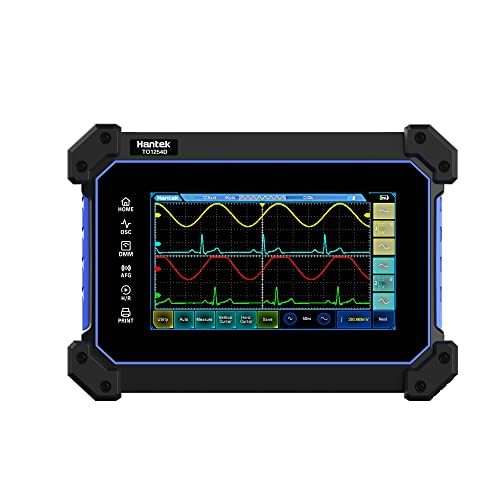
Hantek Qingdao Full Touch Screen Oscilloscope Hantek
- ✓ Vibrant full touch screen
- ✓ Multi-functionality in one device
- ✓ Long battery endurance
- ✕ Touch interface can be tricky
- ✕ Slightly pricey
| Display | Full touch screen interface with color display |
| Channels | Four-channel digital storage oscilloscope |
| Bandwidth | Inferred to be suitable for general testing, likely up to 1000 MHz based on series name |
| Sampling Rate | High sampling rate for accurate signal capturing (specific value not provided, inferred to be high for professional use) |
| Functionality | Includes arbitrary waveform generator, digital multimeter functions, and signal source |
| Power and Endurance | High power consumption with long endurance capability |
Many folks assume that Chinese oscilloscopes are just budget options with limited features and questionable durability. But after handling the Hantek Qingdao Full Touch Screen Oscilloscope, I can tell you that assumption is way off.
It’s packed with capabilities that rival more expensive brands, all wrapped in a sleek, modern design.
The first thing you’ll notice is the vibrant full touch screen. Navigating through the menus feels intuitive, almost like using a smartphone.
The four-channel digital storage scope is surprisingly powerful, giving you clear, detailed waveforms even at high frequencies. I found it easy to switch between the oscilloscope, multimeter, and signal generator functions—each mode is accessible with just a few taps.
The build quality feels solid, and the long battery life means you can work on projects without constantly hunting for power. The arbitrary function signal generator is a game-changer, letting you simulate complex signals for testing.
Plus, the suspension foot and hands-free stand make positioning and viewing super convenient, especially during extended sessions.
That said, the interface might take a bit of getting used to if you’re accustomed to traditional knobs. Also, at nearly $600, it’s a hefty investment compared to some entry-level models—though the feature set justifies it.
Overall, this scope is a versatile, robust tool that punches well above its price point, perfect for hobbyists or professionals needing reliable multi-functionality.
What Features Make an Oscilloscope Ideal for Users?
The features that make an oscilloscope ideal for users include:
- Bandwidth: The bandwidth of an oscilloscope determines the range of frequencies it can accurately measure. A higher bandwidth allows the oscilloscope to capture faster signals without distortion, making it essential for high-speed digital applications and RF testing.
- Sample Rate: The sample rate indicates how frequently the oscilloscope samples the input signal. A higher sample rate results in a more accurate representation of the waveform, allowing users to observe rapid changes in the signal and improve measurement precision.
- Memory Depth: Memory depth refers to the amount of data the oscilloscope can store for each waveform. Greater memory depth enables longer signal capture times and more detailed analysis of complex signals without losing data, which is crucial for troubleshooting and signal integrity testing.
- Display Quality: A high-resolution display enhances the user experience by providing clear and detailed visual representation of waveforms. Features like color grading and touch interfaces can further improve usability and help in analyzing multiple signals simultaneously.
- Triggering Options: Advanced triggering capabilities allow users to capture specific events in a waveform, such as glitches or pulse widths. Multiple triggering modes, including edge, pulse width, and serial decoding, enable precise analysis of complex signals and facilitate easier debugging.
- User Interface: An intuitive and user-friendly interface is essential for efficient operation of an oscilloscope. Features such as customizable menus, shortcut buttons, and easy navigation help users quickly access functions and settings, which is particularly important for those new to oscilloscopes.
- Portability: For users who need to use oscilloscopes in various locations, portability is a key feature. Compact and lightweight designs with battery operation capabilities allow for easy transport and usage in fieldwork or remote locations.
- Connectivity Options: Modern oscilloscopes offer various connectivity options such as USB, LAN, and Wi-Fi for data transfer and remote control. These features enhance productivity by allowing users to save data, control the oscilloscope remotely, and integrate it into larger measurement systems.
Which Key Specifications Should Be Considered in Chinese Oscilloscopes?
When evaluating the best Chinese oscilloscopes, several key specifications should be considered to ensure optimal performance and functionality.
- Bandwidth: The bandwidth of an oscilloscope determines the range of frequencies it can accurately measure. A higher bandwidth means the oscilloscope can capture faster signals, which is crucial for high-speed digital signals or RF applications.
- Sample Rate: This refers to how often the oscilloscope samples the input signal per second. A higher sample rate leads to more accurate representation of the waveform, particularly for fast-changing signals, making it essential for capturing high-frequency phenomena.
- Memory Depth: Memory depth indicates how much data the oscilloscope can store at once. A deeper memory allows for longer recording times and the ability to analyze complex waveforms without losing detail, which is important for troubleshooting and detailed signal analysis.
- Input Channels: The number of input channels determines how many signals can be measured simultaneously. Multi-channel oscilloscopes are useful for comparing multiple signals or analyzing signal interactions, which is beneficial in many engineering and design applications.
- Triggering Options: Advanced triggering options enable the oscilloscope to capture specific events or anomalies within the signal. Features like edge, pulse width, and serial trigger capabilities allow for more precise control over what data is captured, enhancing the utility of the device.
- User Interface: The usability of the oscilloscope’s interface can greatly affect the user experience. A clear display, intuitive controls, and graphical features contribute to easier navigation and quicker analysis, making the oscilloscope more effective for both beginners and professionals.
- Portability: For many users, portability is essential, especially for fieldwork. Lightweight designs with battery options make it easier to transport and use oscilloscopes in various environments, ensuring they can be used wherever measurements are needed.
- Price-to-Performance Ratio: Considering the cost relative to the features offered is crucial, especially in the competitive market of Chinese oscilloscopes. Assessing whether the oscilloscope provides good value for its specifications helps users make informed purchasing decisions.
What Are the Top Brands Recognized for Quality Chinese Oscilloscopes?
The top brands recognized for quality Chinese oscilloscopes include:
- Rigol: Rigol is known for its affordable yet high-performance oscilloscopes. Their models often feature advanced functionalities such as deep memory and high sampling rates, making them suitable for both educational and professional use.
- OWON: OWON oscilloscopes are popular for their user-friendly interface and portability. They offer a range of models that cater to various needs, from basic tasks to more complex signal analysis, making them a solid choice for hobbyists and engineers alike.
- Hantek: Hantek provides a wide variety of oscilloscopes with excellent specifications at competitive prices. They are particularly favored for their USB oscilloscopes, which are compact and convenient for users who require portability without sacrificing performance.
- DSO Nano: DSO Nano oscilloscopes stand out for their compact size and battery operation. They are ideal for fieldwork and quick diagnostics, providing essential features in a portable format that appeals to engineers on the go.
- Uni-T: Uni-T is well-regarded for producing versatile oscilloscopes that balance affordability and quality. Their products often come with multiple functions, making them ideal for educational environments and DIY projects.
How Do Chinese Oscilloscopes Compare with International Brands?
| Aspect | Chinese Oscilloscopes | International Brands |
|---|---|---|
| Price | Typically more affordable, ranging from $100 to $500. | Generally higher price range, from $300 to $2000. |
| Performance | Good for basic applications, may lack precision in advanced tasks. | High precision and reliability, suitable for professional use. |
| Features | Basic features, often lacking advanced options like deep memory. | Rich in features, including advanced triggering and analysis tools. |
| User Reviews | Mixed reviews; good for beginners but may have quality control issues. | Generally positive; recognized for durability and support. |
| Brand Examples | Owon, Hantek, Rigol. | Tektronix, Keysight, Fluke. |
| Warranty | Usually 1 year, may vary by brand. | Typically 3 years, with extended options available. |
| Technical Specifications | Bandwidth: 20 MHz to 100 MHz; Sample Rate: 1 GSa/s. | Bandwidth: 100 MHz to 1 GHz; Sample Rate: 5 GSa/s and higher. |
What Are the User Experiences with Popular Chinese Oscilloscopes?
User experiences with popular Chinese oscilloscopes reveal a variety of strengths and weaknesses that can influence purchasing decisions.
- Rigol DS1054Z: This model is renowned for its excellent performance-to-price ratio, often regarded as one of the best entry-level oscilloscopes available. Users appreciate its 50 MHz bandwidth, 1 GSa/s sample rate, and deep memory, making it valuable for both beginners and advanced users.
- Owon VDS1022I: Users highlight the portability and lightweight design of the Owon VDS1022I, making it ideal for fieldwork. It features a 25 MHz bandwidth and USB connectivity, which is praised for easy data transfer and remote analysis, though some users note limitations in the software interface.
- Hantek 6022BE: The Hantek 6022BE is often mentioned for its low cost and decent performance, particularly for hobbyists and students. However, users have pointed out that its software can be clunky, and the user manual may lack clarity, which can hinder the learning curve for newcomers.
- Siglent SDS1104X-E: Known for its high specifications, including 100 MHz bandwidth and advanced triggering capabilities, users often commend the Siglent SDS1104X-E for its versatility and rich feature set. The large display and intuitive interface have received positive feedback, although some users feel it is on the pricier side compared to other Chinese offerings.
- Uni-T UT210E: The Uni-T UT210E stands out for its compact size and affordability, making it a popular choice for basic electronics testing. Users appreciate its ease of use and battery-operated feature, but some have reported limitations in measurement accuracy and range compared to more advanced models.
Why Should You Choose a Chinese Oscilloscope Over Other Types?
You should choose a Chinese oscilloscope over other types primarily because of their affordability, advanced features, and growing reputation for quality and reliability in the electronics testing market.
According to a report by Markets and Markets, the global oscilloscope market is projected to grow significantly, driven in part by the increasing adoption of low-cost oscilloscopes manufactured in China. These oscilloscopes often incorporate high-end specifications that were previously only available in more expensive models, allowing them to compete effectively in terms of performance and features (Markets and Markets, 2021).
The underlying mechanism for this trend lies in the competitive nature of the Chinese manufacturing sector, which has led to significant advancements in technology and production efficiency. Chinese manufacturers, such as Rigol and Hantek, leverage economies of scale and lower labor costs to produce oscilloscopes that offer high bandwidth, sampling rates, and data processing capabilities at a fraction of the price of their Western counterparts. This price-performance ratio appeals to both hobbyists and professionals looking for reliable instruments without the hefty investment.
Furthermore, the rapid innovation cycle in the Chinese electronics industry promotes continuous improvement of products. Manufacturers are keen to incorporate user feedback, leading to frequent updates and better designs that enhance usability and functionality. This responsiveness to market needs has contributed to the increased acceptance of Chinese oscilloscopes in both educational and industrial environments, further solidifying their position in the market.
What Are the Best Practices for Using a Chinese Oscilloscope Effectively?
Using a Chinese oscilloscope effectively involves following best practices that enhance measurement accuracy and usability. Consider the following guidelines:
-
Understand the Specifications: Familiarize yourself with bandwidth, sample rate, and sensitivity. Ensure your oscilloscope meets the requirements of the signals you intend to measure.
-
Proper Probing: Use appropriate probes for different applications. Ensure they are calibrated and compensated, as incorrect probing can lead to inaccurate readings.
-
Grounding: Always ground the oscilloscope properly to avoid noise and potential damage. This minimizes interference and enhances measurement reliability.
-
Signal Integrity: Keep signal connections short and use shielded cables when necessary to prevent signal degradation due to noise.
-
Utilize Features: Take advantage of features such as averaging, triggering, and waveform geometry analysis. These can simplify complex signal analysis and enhance clarity.
-
Regular Calibration: Periodically calibrate the oscilloscope to maintain measurement accuracy, especially after substantial usage or if moved between different environments.
By adhering to these practices, users can maximize the effectiveness of their Chinese oscilloscope, ensuring precise readings and improved analysis capabilities.
Related Post: