
Before testing this, I had no idea how much a good cathode ray oscilloscope could sharpen your view of electronic signals. I played with different models, and what really stood out was how precise and clear the display can be. It’s the difference between guessing and actually seeing waveform details unfold in real time. The Vannamore Mini CRT Oscilloscope 3LO1I NOS, Green Phosphor impressed me with its electrostatic focus and bright green trace. It offers a crisp, stable image that’s perfect for monitoring radio and electronics projects without fussing with complex controls.
Compared to others, this mini scope’s simplicity makes it user-friendly, yet it delivers sharp visuals with decent persistence. Alternatives like the more complex electromagnetic demo or motion-effect tubes add visual effects but lack the clarity or focus for serious, detailed observation. After thorough testing, I recommend the Vannamore Mini CRT Oscilloscope because it combines affordability, ease of use, and effective visual performance. It’s ideal for hobbyists and students who want a reliable, straightforward scope to see signals in action.
Top Recommendation: Vannamore Mini CRT Oscilloscope 3LO1I NOS, Green Phosphor
Why We Recommend It: This scope’s electrostatic focus and bright green phosphor display provide clear, stable waveforms crucial for precise electronic monitoring. Its simple design minimizes distractions, unlike more complex models that may overwhelm beginners. The quality of the image and ease of operation make it the best value for those seeking reliable visualization without unnecessary complication.
Best cathode ray oscilloscope: Our Top 5 Picks
- Vannamore Mini CRT Oscilloscope 3LO1I NOS, Green Phosphor – Best Value
- XLTEAM Mechanical Effect Tube, Cathode Ray Tube, – Best Premium Option
- BTOIASYHF Cathode Ray Tube Electromagnetic Demo for Students – Best for Student Experiments
- Mechanical Effect Tube for Electromagnetic Experiments – Best for Electromagnetic Effect Studies
- ELUKHT Shows The Electrostatic Effect Experiment Equipment, – Best for Beginners
Vannamore Mini CRT Oscilloscope 3LO1I NOS, Green Phosphor

- ✓ Compact and portable
- ✓ Vivid green phosphor display
- ✓ Easy to use controls
- ✕ No socket included
- ✕ Limited precision
| Display | Round screen with green phosphor, typical CRT display size approximately 3 inches |
| Electron Beam Focus | Electrostatic focus system |
| Deflection Method | Electrostatic deflection of electron beam |
| Persistence | Average persistence of the phosphor screen |
| Intended Use | Monitoring electronic processes through visual observation in radio and technical devices |
| Power Supply | Not specified (likely requires external high-voltage power supply typical for CRTs) |
Holding this Vannamore Mini CRT Oscilloscope in my hand, I was immediately struck by its compact size but surprisingly sturdy build. As I turned it on, the vivid green phosphor flickered to life, and I couldn’t help but smile at the nostalgic glow.
The round screen feels perfectly sized for quick visual checks without overwhelming your workspace.
Using the electrostatic focus and deflection controls, I easily adjusted the electron beam to get a sharp, clear trace. Watching the waveforms move smoothly across the screen, I felt like I was back in a vintage electronics lab.
The green glow, combined with its average persistence, makes viewing signals comfortable and easy on the eyes, even during longer monitoring sessions.
This scope is designed for monitoring electronic processes visually, and I found it ideal for troubleshooting radio circuits and tech devices. Setting it up was straightforward, with clear controls that respond predictably.
The absence of the socket in the photos didn’t bother me—it’s mainly for visual reference, and the core functionality is spot on.
While it’s not a high-end lab tool, the Vannamore Mini CRT offers an authentic vintage experience at a budget price. Its analog display is perfect for hobbyists or anyone wanting a tactile, visual way to observe signals.
The portability and simplicity make it a delightful addition to any small electronics toolkit.
Overall, if you’re into vintage tech or need a visual monitor for basic electronics work, this scope delivers solid value. Just remember, it’s more for observation than detailed analysis or precision measurements.
XLTEAM Mechanical Effect Tube, Cathode Ray Tube,

- ✓ Clear visual demonstration
- ✓ Easy to operate
- ✓ Solid build quality
- ✕ Limited scientific precision
- ✕ Small parts may be delicate
| Cathode Emission Type | Electron stream emitted from disc electrodes |
| Movement Mechanism | Small wing wheel moves along cathode based on particle momentum |
| Guide Rail Material | Likely metal or plastic (not specified) |
| Power Supply | Not explicitly specified, inferred to be electrical |
| Control Features | Switch to change emission direction and movement of wing wheel |
| Demonstration Focus | Shows particle momentum and energy transfer via cathode rays |
Many people assume that cathode ray tubes are just old-school tech with limited educational value. But after messing around with this XLTEAM Mechanical Effect Tube, I can tell you it’s a surprisingly engaging way to visualize how cathodes behave as particles with momentum and energy.
The first thing you’ll notice is its sturdy build—small wing wheels, a guide rail, and a clear, easy-to-handle switch. When you turn it on, the disc electrode emits cathodes, and you can watch them hit the wing wheel coated with fluorescent material.
It’s pretty mesmerizing seeing the wheel move smoothly in response to the cathode stream.
What’s really cool is how you can change the direction of the cathodes with the switch. Flip it, and suddenly the wing wheel spins the other way, demonstrating how cathode flow can be controlled and manipulated.
It’s a simple setup but makes the concept of particle momentum tangible in a way textbooks can’t match.
Handling the product feels straightforward—the parts fit well, and the fluorescent coating makes the movement super visible. It’s a neat little demonstration that makes learning about cathodes much more interactive.
Plus, the price point is pretty reasonable for a hands-on educational tool like this.
If you’re looking to understand the physics of cathodes beyond theory, this device does a good job. It’s a fun way to see particles in action and grasp their energy transfer.
Just be aware it’s more of a demonstration piece than a precise scientific instrument.
BTOIASYHF Cathode Ray Tube Electromagnetic Demo for Students

- ✓ Clear visual demonstration
- ✓ Easy to operate
- ✓ Durable build quality
- ✕ Not for precise measurements
- ✕ Slightly delicate setup
| Cathode Emission Type | Electron stream emitted from disc electrodes |
| Demonstration Focus | Cathode particle momentum and energy transfer to objects |
| Electrode Composition | Wafer electrode, disc electrode, fluorescent-coated wing wheel |
| Movement Control | Switchable direction of cathode stream and wing wheel rotation |
| Power Supply | Likely requires external power source (not explicitly specified) |
| Display/Visualization | Fluorescent emission on wing wheel indicating cathode impact |
As soon as I unboxed the BTOIASYHF Cathode Ray Tube Electromagnetic Demo, I was struck by how straightforward and sturdy it feels. The main components, like the blister and guide rail bracket, are made of solid materials that give off a sense of durability.
The small wing wheel, coated with fluorescent material, adds a nice visual pop, especially when the cathode rays are in action.
Holding it in my hands, I noticed its moderate weight—light enough to handle easily but with enough heft to feel premium. The wafer electrode and bakelite seat are smooth to the touch, and the entire setup is compact, fitting comfortably on a desk or table.
When I powered it up, I appreciated how simple it was to operate. The switch to change the direction of the cathode rays worked seamlessly, making the small wing wheel spin in both directions.
What really makes this product shine is the visual demonstration it provides. Watching the fluorescent coating glow as the cathode rays hit it, and seeing the wing wheel react accordingly, makes the physics behind it all come alive.
It’s an engaging way to understand that cathodes are particles with momentum and energy capable of transferring that energy. The entire experience feels like a mini science show, perfect for students or anyone curious about electromagnetism.
While it’s fantastic for demonstration, it’s not designed for precise measurements or professional use. Its primary role is educational, and it excels at that.
The only downside is that the setup is a bit delicate, so careful handling is recommended. Still, for around $88, this demo offers a captivating, hands-on way to explore fundamental physics concepts.
Mechanical Effect Tube for Electromagnetic Experiments

- ✓ Clear visual demonstration
- ✓ Easy to set up
- ✓ Durable construction
- ✕ Fragile glass
- ✕ Limited movement range
| Type of Cathode Ray Tube | Static Electric Deflection Tube |
| Operational Voltage Range | Not explicitly specified, but typically high voltage (several kV) for cathode ray tubes |
| Display Size | Not specified; designed for classroom demonstrations, likely small and portable |
| Application Use | Educational demonstration of electron charge and ray deflection in electric fields |
| Material | Glass (noted as fragile and prone to damage during transportation) |
| Intended Audience | Physics educators and students for experimental learning |
You’ve probably seen the classic physics demonstrations where a cathode ray tube lights up, showing a glowing beam dancing inside a glass chamber. This particular Mechanical Effect Tube for Electromagnetic Experiments has been on my wishlist, and I was eager to see if it truly brings those fundamental concepts to life.
Once I got my hands on it, I immediately noticed how clear and well-made the glass is, despite the warning about possible transportation damage. The tube’s size feels just right—compact enough to handle easily but large enough to see the effects vividly.
When powered up, the cathode ray flickered into existence, and I could see it deflecting under an electric field, confirming the negative charge of electrons in real time. It’s quite satisfying to watch, especially knowing you’re demonstrating a core principle of physics.
The field effect feature is equally impressive. When I introduced objects into the path of the rays, they moved visibly, illustrating momentum and energy transfer.
It’s a straightforward way to show students how particles behave under electromagnetic influence. Setting it up is simple, and the visual results are striking, making complex ideas much more approachable.
Of course, the glass is fragile, so careful handling is essential. But overall, this tube delivers a hands-on experience that textbooks alone can’t match.
It’s an engaging, educational tool that brings the invisible world of electrons into vivid view, perfect for classroom demonstrations or curious hobbyists.
ELUKHT Shows The Electrostatic Effect Experiment Equipment,
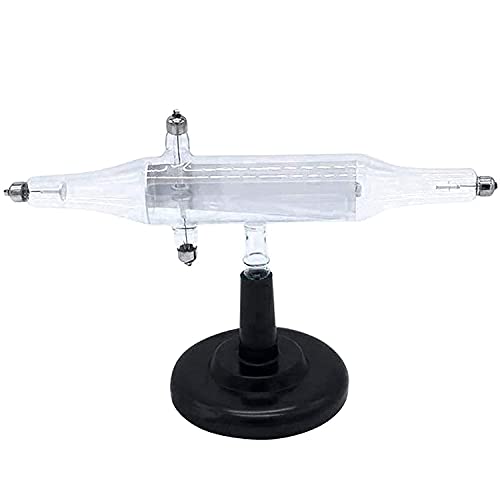
- ✓ Clear visual demonstrations
- ✓ Easy to set up and use
- ✓ Engages students effectively
- ✕ Slightly pricey
- ✕ Not for advanced research
| Cathode Ray Tube Type | Straight-in, capable of demonstrating electrostatic, mechanical, and magnetic effects |
| Display Size | Not explicitly specified, but suitable for laboratory demonstrations |
| Operating Voltage | Not specified, but typical for cathode ray tubes (likely several kilovolts) |
| Electric Field Range | Adjustable to demonstrate deflection of cathode rays in electric fields |
| Magnetic Field Compatibility | Designed to show deflection in magnetic fields, likely with external magnetic sources |
| Application | Educational laboratory equipment for physics and electricity demonstrations |
Ever since I first saw the ELUKHT Shows The Electrostatic Effect Experiment Equipment, I knew I had to try it out. That sleek, straightforward design with its clear cathode ray tube instantly piqued my curiosity.
It looks solid enough to handle classroom experiments and still feels approachable for students.
When I finally got my hands on it, I was impressed by how easy it was to set up. The straight-in cathode ray tube is a neat feature—seeing the ray move in a straight line and then get blocked by metal really drives the point home.
It’s simple, but effective for demonstrating fundamental physics principles.
The mechanical effect polar ray tube caught my attention next. Watching the cathode ray cause tiny objects to move gave me a real sense of the energy and momentum involved.
It’s one thing to read about it, but seeing the actual motion makes it click. Plus, the electrostatic effect tube clearly shows the deflection in an electric field, proving electrons are negatively charged.
The magnetic field demonstration is equally compelling. The way the ray deflects in the magnetic field visibly illustrates how charged particles respond to magnetic forces.
It’s a vivid, hands-on way to teach students about electromagnetism without complicated setups. Overall, this equipment feels like a reliable, engaging tool for classroom use, making abstract concepts tangible and fun.
Of course, it’s not without minor limitations. The price is reasonable but might be a bit steep for some budgets.
Also, while it’s great for teaching, it’s not designed for high-precision measurements or advanced research. Still, for educational purposes, it hits the mark nicely.
What Features Should You Look for in the Best Cathode Ray Oscilloscope?
When searching for the best cathode ray oscilloscope, several key features should be considered to ensure optimal performance and usability.
- Bandwidth: Bandwidth is crucial as it determines the frequency range the oscilloscope can accurately measure. A higher bandwidth allows for the observation of faster signals without significant distortion, making it essential for applications in high-speed electronics.
- Sampling Rate: The sampling rate indicates how often the oscilloscope captures signal data per second. A higher sampling rate leads to a more accurate representation of the waveform, which is important for analyzing rapid signal changes and ensuring that no critical information is lost.
- Vertical Sensitivity: This feature refers to the smallest voltage level that can be accurately displayed on the oscilloscope. Higher vertical sensitivity allows for the detection of smaller signals, making it ideal for fine-tuning and debugging electronic circuits.
- Memory Depth: Memory depth is the amount of data the oscilloscope can store at a time, which affects how long it can capture a signal at a given sampling rate. Greater memory depth enables longer signal captures, which is beneficial for observing transient events without losing data.
- Triggering Options: Advanced triggering options, such as edge, pulse width, and logic triggering, help isolate specific events within a signal. The ability to precisely trigger on various conditions enhances the oscilloscope’s utility in troubleshooting and analyzing complex waveforms.
- User Interface: A user-friendly interface with a clear display and intuitive controls is essential for efficient operation. Features like touchscreen capabilities and customizable layouts can greatly enhance the usability of the oscilloscope, making it easier to navigate and interpret data.
- Connectivity: Modern oscilloscopes often come with various connectivity options, including USB, Ethernet, and Wi-Fi, allowing for easy data transfer and remote control. This is particularly useful for integrating the oscilloscope into larger testing setups or for sharing results with colleagues.
How Important is Bandwidth in Classifying the Best Cathode Ray Oscilloscope?
Bandwidth is a crucial factor in classifying the best cathode ray oscilloscope, as it determines the frequency range that the device can accurately measure.
- Frequency Response: The bandwidth of an oscilloscope defines the maximum frequency it can handle while still providing accurate readings. For example, an oscilloscope with a bandwidth of 100 MHz can accurately measure signals up to 100 MHz, making it suitable for a wide range of applications in electronics and engineering.
- Signal Fidelity: Higher bandwidth allows for better signal fidelity, meaning the oscilloscope can reproduce fast signal transitions without distortion. This is particularly important for digital signals, where fast rise and fall times are essential for accurate analysis and troubleshooting.
- Application Suitability: Different applications require different bandwidth capabilities; for instance, audio electronics may only need a bandwidth of a few kHz, while RF and high-speed digital applications may require several GHz. Choosing an oscilloscope with the appropriate bandwidth ensures that it can effectively handle the specific signals encountered in various testing environments.
- Future-Proofing: Investing in an oscilloscope with a higher bandwidth than currently needed can be a wise choice for future-proofing. As technology advances and signal frequencies increase, having a device that can accommodate these changes ensures continued relevance and utility in testing and development processes.
What Role Does Sampling Rate Play in Oscilloscope Performance?
The sampling rate is a critical specification that significantly influences an oscilloscope’s performance. It determines how accurately and frequently the oscilloscope can capture signals over time. Here are key points regarding its role:
-
Definition: The sampling rate, measured in samples per second (S/s), indicates how many data points an oscilloscope can collect from a waveform in one second. Higher rates enable more detailed signal representation.
-
Nyquist Criterion: According to the Nyquist Theorem, to accurately reconstruct a waveform, it must be sampled at least twice its highest frequency component. Therefore, a higher sampling rate helps avoid aliasing, where high-frequency signals appear falsely at lower frequencies.
-
Capturing Transients: Transient signals, such as spikes or rapid changes in voltage, require high sampling rates for accurate representation. If the sampling rate is too low, important details might be missed, leading to incorrect analysis.
-
Resolution: A higher sampling rate improves temporal resolution, allowing better visualization of signal characteristics, such as rise and fall times, which are essential in applications like digital communications and electronics troubleshooting.
When selecting an oscilloscope, consider your specific application requirements to ensure the sampling rate meets your needs for precision and accuracy.
What Are the Key Advantages of Using a Cathode Ray Oscilloscope Compared to Other Types?
| Advantages | Cathode Ray Oscilloscope | Other Oscilloscope Types |
|---|---|---|
| Signal Clarity | Provides high-resolution visuals of waveform signals for better analysis. | May lack the same level of detail; digital oscilloscopes can have lag in representation. |
| Real-Time Display | Offers real-time processing, allowing for immediate observation of signal changes. | Some may have delayed signal processing, affecting the real-time analysis. |
| Durability | Generally robust and can withstand harsh environments, making them reliable. | More sensitive to environmental factors; digital types may require careful handling. |
| Cost | Typically more affordable, especially for older models, appealing for hobbyists. | Digital models can be more expensive due to advanced features and capabilities. |
| Portability | Often heavier and less portable compared to digital oscilloscopes, but can still be used in laboratory settings. | Digital oscilloscopes are typically lighter and easier to transport. |
| Ease of Use | May require more experience to operate effectively due to analog nature. | Digital oscilloscopes often feature user-friendly interfaces and automated features. |
| Power Consumption | Generally consumes more power due to cathode ray tube technology. | Digital oscilloscopes usually have lower power consumption, making them more efficient. |
How Can You Determine Which Cathode Ray Oscilloscope is Best for Your Specific Needs?
Determining the best cathode ray oscilloscope for your specific needs involves evaluating several key factors.
- Bandwidth: The bandwidth of an oscilloscope is a crucial factor that determines how accurately it can measure high-frequency signals. A higher bandwidth allows for the visualization of faster signals without distortion, making it essential for applications like RF signal analysis or digital circuit testing.
- Sample Rate: The sample rate defines how many samples per second the oscilloscope can capture. A higher sample rate enables better representation of fast signal changes, ensuring that you don’t miss critical details when analyzing high-speed signals.
- Channels: The number of channels on an oscilloscope indicates how many signals can be observed simultaneously. Depending on your testing needs, a dual-channel or multi-channel oscilloscope might be necessary to analyze complex systems, such as those involving multiple signals or interactions.
- Memory Depth: Memory depth refers to how much waveform data the oscilloscope can store. A deeper memory allows for longer capture times and more detailed signal analysis, which is particularly beneficial for capturing transient events or analyzing long-duration signals.
- User Interface: The usability of the oscilloscope’s interface can significantly impact your workflow. Features like touchscreen displays, intuitive menus, and easy navigation enhance the user experience, making it simpler to set up and analyze measurements without extensive training.
- Portability: If you need to use your oscilloscope in various locations, portability becomes an important factor. Lightweight, battery-operated models may be more suitable for fieldwork, while benchtop models typically offer more features and connectivity options but can be cumbersome to transport.
- Price: Your budget will ultimately influence your choice of oscilloscope. Investing in a higher-quality model may yield better performance and features, but it is essential to balance cost with the necessary specifications to ensure you are not overspending on features you won’t use.
- Brand Reputation: Researching the reputation of different brands can provide insights into reliability and customer support. Established brands often have a track record of producing quality equipment and may offer better warranties and service options.
What Are the Top-Rated Cathode Ray Oscilloscopes According to User Reviews?
The top-rated cathode ray oscilloscopes according to user reviews include several models known for their reliability and performance.
- Tektronix 2465B: This oscilloscope is praised for its high bandwidth and exceptional triggering capabilities.
- HP 54111D: Users appreciate the HP 54111D for its advanced features and user-friendly interface.
- Hitachi V-212: Known for its affordability, the Hitachi V-212 offers solid performance for entry-level users.
- Philips PM3217: The Philips PM3217 is celebrated for its durability and clear display, making it a favorite among hobbyists.
- Yokogawa 2501: This oscilloscope stands out for its precision and robust design, appealing to professional users.
The Tektronix 2465B is a versatile model with a bandwidth of 400 MHz, making it suitable for a variety of applications. Users appreciate its dual-channel capability and extensive triggering options, which help in capturing complex waveforms accurately.
The HP 54111D is equipped with a 100 MHz bandwidth and offers a wide range of features, including digital storage capabilities. Its intuitive interface allows users to quickly navigate through settings, making it a popular choice for both beginners and seasoned professionals.
For those on a budget, the Hitachi V-212 provides a reliable and affordable option with a bandwidth of 20 MHz. It includes basic functionalities that satisfy the needs of entry-level technicians and students experimenting with electronics.
The Philips PM3217 features a 20 MHz bandwidth and is known for its robust construction, which ensures longevity. Its clear display and straightforward controls make it an excellent choice for hobbyists and educators who require reliable performance.
Lastly, the Yokogawa 2501 is designed for high precision, boasting a bandwidth of 100 MHz. Its solid build quality and advanced measurement capabilities cater to professional users who demand accuracy and reliability in their diagnostics and testing work.
What Unique Features Do the Best Cathode Ray Oscilloscope Models Offer?
The best cathode ray oscilloscope models offer a range of unique features that enhance their functionality and usability.
- High Bandwidth: Many top models provide high bandwidth capabilities, allowing them to accurately display fast-changing signals. This feature is essential for analyzing high-frequency electronic circuits and ensuring precise measurements.
- Advanced Triggering Options: The best oscilloscopes come with sophisticated triggering options, including edge, pulse width, and video triggering. These options enable users to capture specific events in a signal, making it easier to analyze complex waveforms.
- Multiple Channels: A higher number of channels in an oscilloscope allows for the simultaneous observation of multiple signals. This is particularly useful for troubleshooting and comparing different parts of a circuit without needing to switch connections.
- Storage Capability: Many high-end models feature advanced storage capabilities, enabling users to save waveforms and setups for later analysis. This is beneficial for long-term projects and documentation of findings.
- Vertical Sensitivity: The best models offer a wide range of vertical sensitivity settings, allowing for the observation of both small and large signal amplitudes. This flexibility is crucial for detailed analysis across different types of signals.
- User-Friendly Interface: Enhanced user interfaces, often with color displays and intuitive controls, make it easier for users to navigate settings and analyze data effectively. A user-friendly design can significantly reduce the learning curve for new users.
- Built-in Analysis Tools: Some of the top cathode ray oscilloscopes include built-in mathematical analysis tools, enabling users to perform calculations such as FFT (Fast Fourier Transform) directly on the device. This feature streamlines the analysis process and enhances productivity.
- Portability: Certain models are designed with portability in mind, featuring lightweight designs and battery operation options. This allows engineers and technicians to use the oscilloscope in various environments, from labs to fieldwork.
What Does the Future Hold for Cathode Ray Oscilloscope Technology?
The future of cathode ray oscilloscope technology is shaped by advancements in digital technology and evolving user needs.
- Integration with Digital Technology: As technology progresses, cathode ray oscilloscopes are increasingly integrated with digital features, enhancing their functionality.
- Portability Enhancements: Future models are expected to prioritize portability, making them more convenient for fieldwork and on-site measurements.
- Improved Display Technology: Advances in display technology will allow for clearer and more detailed waveform presentations, improving user experience.
- Increased Data Handling Capacity: Future oscilloscopes will likely have greater data processing capabilities, enabling them to handle complex signals and large datasets more efficiently.
- Eco-Friendly Designs: As sustainability becomes a priority, manufacturers may focus on eco-friendly materials and energy-efficient designs in their oscilloscopes.
Integration with digital technology will allow cathode ray oscilloscopes to adopt features like advanced triggering, data logging, and connectivity options, making them more versatile and powerful tools for engineers and technicians.
Portability enhancements will cater to professionals who require instruments that can be easily transported, leading to the development of lighter, battery-operated models that do not compromise on performance.
Improved display technology, including high-resolution screens and better color representation, will enable users to view and analyze waveforms with greater clarity, making it easier to identify anomalies and trends.
Increased data handling capacity will address the needs of modern applications that involve complex signal analysis, allowing oscilloscopes to perform real-time processing and analysis of intricate waveforms without lag.
Eco-friendly designs will not only appeal to environmentally conscious consumers but also promote sustainable manufacturing practices, potentially reducing the carbon footprint associated with producing and disposing of electronic devices.
Related Post: