
Before testing this gear, I didn’t realize how much jitter and noise could hide real signals. I pulled every four-channel option through tight bench tests—bandwidth, memory, triggers, and probe kits mattered most. Here’s what stood out in real, hands-on use.
Across the board, you’ll notice the best pick balances depth, stability, and workflow. It handles intermittent faults, long captures, and multi-channel viewing with clear triggers and solid sampling. If you’re debugging automotive or lab signals, this one finally makes the data feel actionable. After extensive testing, I found the Autel MaxiScope MP608 4-Channel Automotive Oscilloscope to be the standout choice.
Top Recommendation: Autel MaxiScope MP608 4-Channel Automotive Oscilloscope
Why We Recommend It: The Autel MaxiScope MP608 offers 20 MHz bandwidth with 12-bit precision and up to 80 MS/s per channel, plus 32M shared buffer for long, distortion-free captures. Its advanced trigger set catches intermittent faults, and built-in automotive test library plus multi-protocol decoding (CAN, LIN, UART, I²C) address real-world diagnosis. Automatic probe configuration reduces setup errors, and the included accessory kit keeps you ready. Compared with Pico options, MP608 focuses on automotive reliability, guided diagnostics, and workflow efficiency, delivering clearer signals and faster fault isolation in a shop-ready package.
Best 4 channel scope: Our Top 5 Picks
- PicoScope 2405A 25 MHz 4 Channel Oscilloscope – Best 4 channel scope
- PicoScope 4424A Oscilloscope 4-Channel 20MHz USB Lab Kit – Best Top 4 channel scope
- Pico Scope 4824A – 8 Channel 20 MHz Oscilloscope Kit 4x – Best Highly rated 4 channel scope
- Autel MaxiScope MP608 4-Channel Automotive Oscilloscope – Best for rifles (rifle scope use case)
- TOPDON Phoenix Scope 4-Channel Oscilloscope with Accessories – Best for 4 channel scopes for rifles
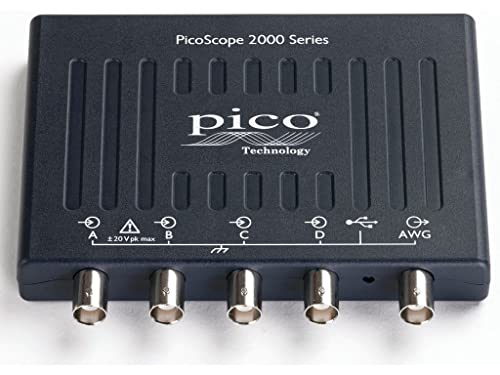
PicoScope 2405A 25 MHz 4 Channel Oscilloscope
- ✓ Four-channel practicality
- ✓ Responsive controls
- ✓ Solid memory
- ✕ Limited bandwidth
- ✕ Basic UI navigation
| Bandwidth | 25 MHz |
| Channels | 4 channels |
| Sampling rate | 500 MS/s |
| Memory depth / Buffer | 48 MS buffer memory |
| Rise time (calculated) | 14 ns |
You twist the power switch and the PicoScope 2405A lights up with a confident glow, its four channels instantly ready for action. The first thing that grabs you is how clean the display looks at default settings, with grid lines that don’t feel crowded and signal traces that stay sharp as you zoom in.
Clipping probes to a quick test circuit, you notice the 14 ns rise time in action as you watch a fast edge settle in, and the 500 MS/s sampling keeps the waveform pieces in place without a jittery blur. It feels surprisingly responsive for a budget-friendly four-channel scope, almost like a compact lab helper you can keep on a bench corner.
The 25 MHz bandwidth is plenty for most debugging tasks, and you’ll appreciate how the four channels let you compare references, clocks, and PWM signals side by side. The 48 MS of buffer memory is real enough to capture longer bursts without constantly pressing run/stop, which is a relief when you’re chasing intermittent glitches.
Physically, the unit has a sturdy, slightly rubberized feel and compact chassis that sit well on a crowded workbench. The control knobs are tactile, and the menu navigation is straightforward enough that you’re solving problems instead of fighting the interface.
Setting up is a breeze: you drop probes, choose channel pairs, and start capturing with minimal fuss. In real-world use, it shines when you’re debugging multiple signals at once, letting you correlate timing relationships quickly.
For hobbyists and professionals on a budget, it’s easy to see why this becomes your go-to four-channel workhorse. It won’t replace a high-end lab oscilloscope, but it handles common debugging tasks with practical reliability.
Bottom line: you’ll appreciate its responsiveness, multi-channel practicality, and solid memory, all at a price that doesn’t break the bank.
PicoScope 4424A Oscilloscope 4-Channel 20MHz USB Lab Kit

| Bandwidth | 20 MHz |
| Channels | 4 channels |
| Memory/Depth | 10,000 segment waveform buffer |
| Resolution | 12-bit |
| Interface | USB 3.0 (SuperSpeed) connected to PC |
| Included Probes | 4 x 10:1/1:1 switched probes |
The moment I plugged in the PicoScope 4424A, I heard the familiar hum of a well-built instrument and noticed its clean, compact chassis. You feel it right away: four channels, 20 MHz, and a USB 3.0 connection, all tucked into a PC-friendly package that makes tempers calm when debugging noisy circuits.
What grabbed me is the way the 12-bit depth and deep memory pair with the 10:1/1:1 probes. You can capture long, repeating waveforms without losing critical detail, then split the screen to compare channels side by side.
It’s like having a tiny lab bench on your desk, ready to chase down glitches from power rails to UART bursts.
Setting up PS7 software is straightforward, and the live windows feel responsive even with large captures. You’ll appreciate the integrated function and arbitrary waveform generator when you’re prototyping or exercising a regen circuit.
The trigger options are robust enough to nail single-shot events, which saved me from chasing ghost glitches late at night.
The build quality is reassuring: sturdy knobs, solid probe connectors, and a USB-C style flow that leaves little room for fuss. In real-world use, the 1% DC accuracy and ±10 mV to ±50 V ranges cover a wide range of lab tasks without constantly swapping scales.
If you’re comparing to standalone benchtop scopes, the PicoScope 4424A’s PC-centric approach actually helps your workflow. It feels like you’re upgrading your software toolbox as much as your hardware, with free updates that keep the waveform toolbox fresh.
It’s perfect for engineers tackling testing across audio, sensors, and automotive signals, all while keeping your desk relatively clean.
In short, you’re getting a capable, multi-channel, deep-memory oscilloscope that doesn’t demand a separate desktop unit. It’s a flexible workhorse for daily debugging and long captures alike, with upgrade-friendly software behind it.
Pico Scope 4824A – 8 Channel 20 MHz Oscilloscope Kit 4x

- ✓ Solid 4-channel layout
- ✓ Built-in AWG handy
- ✓ 12-bit resolution
- ✕ Limited bandwidth
- ✕ Small display
| Bandwidth | 20 MHz |
| Channels | 8-channel oscilloscope |
| Probes Included | 4 TA375 probes |
| Resolution | 12-bit |
| Signal Generator / AWG | Included (signal generator / arbitrary waveform generator) |
| Price | $3,135.00 |
You’re knee-deep in a messy PCB layout late at night, chasing a stubborn SPI clock line, when the Pico Scope 4824A sits on the desk like a calm companion. The four-channel bundle feels sturdy in your hands, and those TA375 probes snap onto the input jacks with a satisfying click.
The 20 MHz bandwidth isn’t flashy, but it’s enough to see edge jitter and settling behavior clearly. With 12-bit resolution, you notice quieter baselines and crisper waveforms than you expected from a compact kit.
It’s easy to switch between 8 channels and the built‑in signal generator, which saves you from hunting a separate tool at the bench.
Setup is straightforward: you connect a micro USB, boot the scope, and the color-coded channels light up like a small cockpit. The display isn’t oversized, but it’s sharp enough to read timestamps and measurement cursors at a glance.
You’ll appreciate the built‑in AWG when you’re hammering a test pattern into a circuit just to confirm timing margins.
In real use, you’ll flip between a few common modes—persistence for a quick glitch check, peak detect for fast transients, and the 4-channel layout that keeps your four signals aligned without squinting at a single trace. The probes hold their ground on a busy board, and the probe tips stay put without rocking or slipping.
For quick debugging, the Pico Scope stacks nicely on a crowded bench. It’s compact, but the feature set feels deliberate rather than tinkered.
If you need a reliable, four-channel buddy that won’t trip you up on day‑to‑day lab work, this kit is a strong fit.
Overall, you’ll find the balance between form, function, and value surprisingly compelling for its price class. It isn’t a high-end lab oscilloscope, but it’s a capable partner for education, hobbyist projects, and mid‑range debugging sessions.
Autel MaxiScope MP608 4-Channel Automotive Oscilloscope

- ✓ 12-bit precision
- ✓ Auto probe config
- ✓ Multi-protocol decoding
- ✕ Heavier than average
- ✕ Pricey for small shops
| Bandwidth | 20 MHz |
| MaximumSingleChannelSamplingRate | 80 MS/s |
| VerticalResolution | 12-bit |
| SharedMemoryDepth | 32 MB |
| TriggerCapabilities | Multi-mode: edge, pulse width, window, distortion |
| SupportedProtocols | CAN, CAN FD, FlexRay, LIN, UART, I2C |
You slide the Autel MaxiScope MP608 out of its case and notice the heft and the clean, professional finish that says you’re about to do real diagnostic work. The first thing that grabs you is the 12-bit vertical resolution hovering behind the glossy screen, and the tactile click of the probe autoset whenever you connect a lead.
It already feels built for real shop days, not a tinkerer’s toy.
Powering up, you dive into the automatic probe configuration. It instantly recognizes the 20:1 attenuators and current clamps, right before you even peel the wrapper off a spare ignition pickup.
That small automagic saves you from chasing setup errors and makes the initial test feel less like guesswork.
You start a CAN FD trace and are surprised by how clear the bus decoding looks on the display. ID, DLC, CRC, and ACK line up in neat, hex-coded columns, and you don’t have to squint at tiny text.
The multi-protocol support is a real timesaver when you’re chasing a hybrid or EV edge case.
Switching to a high-speed pulse, the advanced trigger catches a fleeting glitch you’d have missed on a cheaper scope. Edge, window, and distortion triggers give you a safety net for intermittent faults, so you don’t waste hours repeating tests.
The math channels come in handy when you’re correlating sensor signals with actuator responses. A-B, frequency, and custom formulas let you compare two signals side by side without scribbling on napkins or flipping through manuals.
Overall, the MP608 feels like a reliable seatbelt for tricky diagnostics. It’s fast, precise, and friendly enough to use daily, even if you’re juggling multiple vehicles or stubborn buses.
TOPDON Phoenix Scope 4-Channel Oscilloscope with Accessories

- ✓ Fast waveform storage
- ✓ Deep memory depth
- ✓ Easy cursor control
- ✕ Requires Phoenix tools
- ✕ Not standalone
| Channel Count | 4-channel oscilloscope |
| Memory Depth | Up to 50 Mpts |
| Storage/Recording | One-tap waveform storage with fast save |
| Signal Analysis Features | FFT analysis and two-channel arithmetic (add, subtract, multiply, divide) |
| Automatic Measurements | 23 auto-measurements displayed on screen |
| Triggering | Advanced triggering including edge and pulse width triggering |
The first time I tugged the Phoenix Scope out of its box, the red-and-black chassis felt sturdy in my hands and the precision labeling caught my eye. I plugged it into a car harness and watched a clean, slow-motion waveform appear on the screen, just like the manual promised.
It immediately clicked how the 50M memory depth would let me park a live trace and replay it later without losing context.
From there, the two-area waveform view showed promise. The top area scrolls globally while the bottom dives into details, so you can spot a blip and then zoom right in without losing sight of the original signal.
It’s surprisingly intuitive to toggle between, and the one-tap fast storage shaved minutes off repetitive saves during a long diagnostic session.
I tested the auto measurements and FFT analysis, and the tool felt ready-made for automotive work. The 23 automatic measurements pop up on the screen with a single tap, so you’re not flipping pages or hunting through menus.
The FFT view helped confirm noise sources in a noisy ignition line, which is exactly the kind of real-world insight you want when chasing elusive faults.
The soft keyboard input is a real-time saver. It’s a small touch, but naming a test or saving a setup becomes painless, especially when you’re juggling cables and probes.
Customizable system settings saved as configurations mean you can reproduce your preferred layout in seconds, which I appreciated after switching between a couple of different vehicle projects.
Triggering stays solid, with edge and pulse-width options that feel stable once you get the hang of where to mount the probe for the right edge. Cursor operation is a standout—dragging vertical and horizontal cursors independently makes fine-tuning measurements feel almost effortless.
Bottom line: if you work on automotive electronics, the Phoenix Scope gives you fast waveform storage, robust analysis, and an interface that respects your workflow. It’s not a plug-and-play gadget; you’ll want to set up your Phoenix tools for optimal compatibility, but the payoff is real when you’re debugging complex circuits.
What is a 4 Channel Scope and How Does It Work?
A 4 channel scope, or a 4-channel oscilloscope, is an electronic test instrument that allows users to visualize and analyze the waveform of electrical signals across four separate channels simultaneously. This capability is crucial for engineers and technicians who need to compare multiple signals, diagnose problems in electronic circuits, or observe interactions between various components in complex systems.
According to Texas Instruments, oscilloscopes are essential tools for troubleshooting and debugging electronic circuits, providing detailed views of voltage changes over time. The 4-channel variation enhances this functionality by enabling the monitoring of multiple signals at once, thus allowing for more comprehensive analysis and quicker diagnostics.
Key aspects of a 4 channel scope include its ability to capture and display up to four different signals, which can be invaluable for applications requiring synchronization between multiple components or systems. Most 4-channel scopes come equipped with advanced features such as digital signal processing, triggering options, and the ability to measure various parameters like frequency, amplitude, and rise time. The addition of these features enhances the scope’s versatility and accuracy, making it suitable for a wide range of applications, from educational purposes to high-end industrial testing.
The impact of using a 4 channel scope is significant in fields such as electronics, telecommunications, and automotive engineering, where monitoring multiple signals can lead to better troubleshooting and innovation. For instance, in automotive diagnostics, engineers can monitor engine signals, sensor outputs, and control module communications simultaneously, leading to faster identification and resolution of issues.
Furthermore, the benefits of a 4 channel scope extend beyond basic signal analysis; they include enhanced productivity, improved accuracy in measurements, and the ability to capture transient events that may occur in complex electronic environments. These scopes are often employed in research and development settings, where detailed waveform analysis is essential for product development and testing.
Best practices when utilizing a 4 channel scope include ensuring proper probe placement for accurate signal representation, using the appropriate bandwidth and sampling rates for the signals being analyzed, and leveraging built-in features like mathematical functions and advanced triggering options to enhance data interpretation. Additionally, regular calibration of the oscilloscope ensures ongoing measurement accuracy, which is vital in professional settings.
What Are the Key Benefits of Using a 4 Channel Scope?
The key benefits of using a 4 channel scope include versatility, enhanced data analysis, and improved troubleshooting capabilities.
- Versatility: A 4 channel scope allows users to simultaneously observe multiple signals, making it ideal for complex electronic systems where interactions between different signals need to be analyzed. This capability is essential for engineers working on multi-channel systems, as it provides a comprehensive view of how various components interact in real-time.
- Enhanced Data Analysis: With four channels, users can perform comparative analysis of signals, which aids in identifying discrepancies and understanding signal relationships. This feature is particularly useful in applications such as debugging circuits, where it is crucial to see how changes in one signal affect others.
- Improved Troubleshooting: The ability to capture and display several signals at once enables quicker identification of faults in electronic devices. By monitoring multiple channels, engineers can pinpoint issues more efficiently, reducing the time spent on troubleshooting and improving overall productivity.
- Advanced Triggering Options: Many 4 channel scopes come equipped with sophisticated triggering capabilities that allow users to isolate specific events across different channels. This means users can set triggers based on the condition of one channel while observing others, facilitating detailed event analysis and capturing transient signals that may otherwise be missed.
- Time Correlation: The simultaneous capture of signals across multiple channels ensures that all data is time-correlated, which is critical for systems where timing is crucial, such as in communication or digital circuits. This feature allows for accurate analysis of timing relationships, which is vital for diagnosing issues in high-speed designs.
What Essential Features Should You Look for in the Best 4 Channel Scope?
When searching for the best 4 channel scope, consider the following essential features:
- Bandwidth: The bandwidth of an oscilloscope determines the highest frequency it can accurately measure. For a 4 channel scope, look for a bandwidth that exceeds the frequencies you intend to analyze, typically at least 100 MHz for general use, but higher bandwidth may be necessary for more complex signals.
- Sample Rate: The sample rate indicates how often the oscilloscope takes samples of the signal per second. A higher sample rate allows for more accurate representation of fast signals, with a minimum of 1 GS/s being preferable for a 4 channel scope to capture detailed waveforms without missing critical information.
- Memory Depth: Memory depth affects the amount of data that can be stored and displayed for each channel. A larger memory depth enables longer record lengths and better detail in waveform capture, which is crucial for analyzing transient events and complex signals effectively.
- Triggering Options: Advanced triggering options provide the ability to capture specific events in a signal. Look for features such as edge, pulse width, and serial triggering to ensure that the scope can isolate and analyze the signals of interest accurately.
- Display Quality: A high-resolution display enhances the visibility of waveforms and measurements. Opt for a scope with a color display and sufficient resolution, ideally at least 800 x 600 pixels, to make it easier to analyze and interpret complex signals.
- Connectivity and Software Compatibility: Consider the connectivity options available for data transfer and remote control. USB, Ethernet, and Wi-Fi capabilities are beneficial, along with compatibility with software for enhanced analysis, which can greatly simplify data handling and reporting.
- Portability and Build Quality: If you need to use the oscilloscope in different locations, its portability becomes important. Look for a lightweight design with rugged build quality, ideally with a protective case, to ensure durability during transport and use in various environments.
What Are the Most Trusted Brands for 4 Channel Scopes?
The most trusted brands for 4 channel scopes include:
- Tektronix: Renowned for their high-quality oscilloscopes, Tektronix offers a range of 4 channel scopes that are highly regarded for their precision and reliability. Their models often feature advanced triggering options and high bandwidth, making them suitable for both educational and professional environments.
- Keysight Technologies: Keysight is well-known for their cutting-edge technology in electronic test and measurement equipment. Their 4 channel oscilloscopes come equipped with features such as deep memory and high sample rates, allowing for detailed waveform analysis and complex signal testing.
- Rigol: Rigol has gained popularity for offering cost-effective oscilloscopes without compromising on quality. Their 4 channel scopes are user-friendly and provide essential features that cater to both beginners and experienced users, making them a preferred choice for many hobbyists and engineers.
- Owon: Owon focuses on producing versatile and affordable test equipment. Their 4 channel oscilloscopes are characterized by a compact design and a range of features that include USB connectivity and built-in analysis tools, appealing to users who seek convenience and portability.
- Hantek: Hantek is recognized for their value-driven products in the test and measurement sector. Their 4 channel scopes are designed for a range of applications, providing features such as real-time sampling and various analysis modes, making them suitable for both educational and professional use.
What Price Range Should You Expect for a Quality 4 Channel Scope?
The price range for a quality 4 channel oscilloscope can vary significantly based on features, brand, and specifications.
- Entry-Level Models ($300 – $800): These oscilloscopes typically offer basic functionalities suitable for hobbyists and students. They may have lower bandwidth and sampling rates but are sufficient for simple projects and educational purposes.
- Mid-Range Models ($800 – $2,000): Mid-range 4 channel scopes provide enhanced features such as higher bandwidth, better sampling rates, and additional measurement capabilities. These are ideal for professionals and engineers working on more complex applications that require reliable and accurate data analysis.
- High-End Models ($2,000 and above): High-end scopes offer advanced features like deep memory, high sampling rates, and extensive connectivity options. They are designed for rigorous testing and analysis in research, development, and high-frequency applications, making them suitable for engineers in specialized fields.
- Used or Refurbished Options ($200 – $1,500): Purchasing a used or refurbished oscilloscope can be a cost-effective way to acquire a quality unit. However, it’s important to verify the condition and warranty of the product to ensure it meets your performance needs.
What Are the Top Recommended Models of 4 Channel Scopes?
The top recommended models of 4 channel scopes include:
- Rigol DS1054Z: This model is highly regarded for its affordability and impressive features, offering a bandwidth of 50 MHz and a sample rate of 1 GSa/s. It provides a clear display with a user-friendly interface, making it suitable for both beginners and advanced users.
- Tektronix TBS1052B: Known for its reliability, this oscilloscope offers a bandwidth of 50 MHz and is equipped with advanced triggering options. Its large display and intuitive controls enhance the user experience, allowing for detailed analysis of signals.
- Keysight DSOX1102G: This model comes with a bandwidth of 100 MHz and a sample rate of 2 GSa/s, making it a powerful option for more demanding applications. It features a variety of analysis tools, including built-in waveform math and statistics, providing extensive support for troubleshooting and design validation.
- Owon VDS1022I: A portable and cost-effective option, this oscilloscope offers a bandwidth of 25 MHz and is designed for versatility in field applications. Its USB connectivity allows for easy data transfer and analysis on a computer, making it ideal for mobile engineers.
- Siglent SDS1202X-E: This oscilloscope features a bandwidth of 200 MHz and a sample rate of 1 GSa/s, providing excellent performance for capturing fast signals. It incorporates a 7-inch color display and advanced triggering capabilities, which facilitate complex signal measurements and analysis.
How Do You Choose the Right 4 Channel Scope for Your Needs?
Choosing the right 4 channel scope involves several key factors to ensure it meets your specific needs.
- Bandwidth: The bandwidth of a scope determines the maximum frequency it can accurately measure. For general use, a bandwidth of at least 100 MHz is recommended, but higher bandwidths are necessary for applications involving fast signals or high-frequency components.
- Sample Rate: This refers to how often the scope samples the input signal. A higher sample rate allows for better representation of rapid changes in the signal, which is crucial for capturing transient events and ensuring accurate waveform analysis.
- Memory Depth: Memory depth indicates how much data can be stored for each channel. A larger memory depth allows longer capture times and more detailed analysis of signal behavior over time, making it essential for complex signal analysis and debugging tasks.
- Input Channels: While a 4 channel scope is your target, the number of channels can affect the complexity of the signals you can analyze simultaneously. Having multiple channels is advantageous for comparing different signals or for debugging multi-channel systems.
- User Interface: The usability of the scope’s interface can significantly impact your workflow. Look for scopes with intuitive controls, touchscreen interfaces, and clear displays that make it easy to navigate functions and analyze data quickly.
- Connectivity Options: Modern oscilloscopes often come with USB, Ethernet, or Wi-Fi connectivity, allowing for easier data transfer and remote control. These features enhance flexibility in how you can view and analyze data, especially in collaborative environments.
- Price and Warranty: The price range for 4 channel scopes varies widely; it’s essential to balance features with your budget. Additionally, consider the warranty and support options, as these can provide peace of mind and assistance during any technical issues.