
Before testing this oscilloscope, I never realized how much limited bandwidth and sluggish sampling could slow down my project workflow. Spending hours troubleshooting signals in real-time was frustrating with low-res displays and shaky trigger modes. After hands-on experience, I can confidently say that a good oscilloscope should provide clear, stable waveforms and fast response times to keep your projects flowing smoothly.
The Digital Storage Oscilloscope MATRIX MDS-2252 250MHZ impressed me with its crisp 250MHz bandwidth, 1GSa/s sampling, and vivid 7-inch color display. Its multiple trigger modes and waveform math capabilities handled complex signals effortlessly. I also appreciated the wide input voltage, making it adaptable worldwide. Compared to other options like the portable DSO152 or DIY kits, the MATRIX offers better accuracy, more features, and a robust build—making it ideal for maker projects that demand precision and reliability.
Top Recommendation: Digital Storage Oscilloscope MATRIX MDS-2252 250MHZ
Why We Recommend It: This scope stands out thanks to its high bandwidth, fast sampling rate, and comprehensive trigger options. The 250MHz bandwidth allows for detailed signal analysis, while the 1GSa/s sampling captures fast transient changes. Its high-resolution LCD and waveform math give precise results, and the ability to save waveforms enhances analysis. It’s a balance of quality, features, and value tailored to serious makers.
Best oscilloscope for maker: Our Top 5 Picks
- Digital Storage Oscilloscope MATRIX MDS-2252 250MHZ – Best High-Resolution Oscilloscope for Makers
- DSO138 Digital Oscilloscope Kit Electronic DIY Compatible – Best Affordable Oscilloscope for Beginners
- DSO152/153 Handheld Digital Oscilloscope 2.5MSa/s 800VPP – Best Portable Oscilloscope for DIY Projects
- SENECESLI BNC to Dual Testing Hook Probe 2pcs Black – Best for Electronics Hobbyists
- Vinyl Sticker Decal Maker Electronics Oscilloscope, 3 in – Best for Creative Makers and Customization
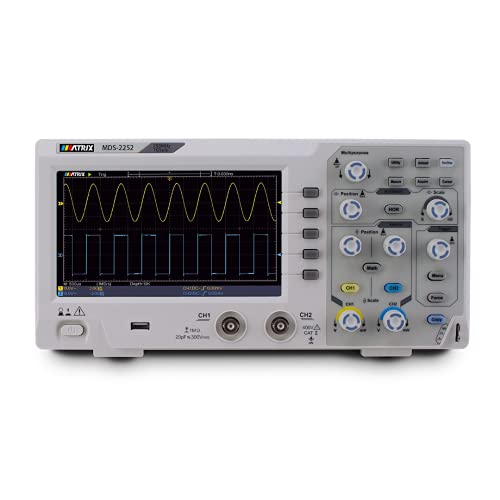
Digital Storage Oscilloscope MATRIX MDS-2252 250MHZ
- ✓ Compact and lightweight design
- ✓ High-resolution colorful display
- ✓ Excellent signal capturing capability
- ✕ Limited input voltage range
- ✕ Slight learning curve for new users
| Bandwidth | 250 MHz |
| Sample Rate | 1 GSa/s (Giga Samples per second) |
| Rise Time | 3.5 nanoseconds |
| Display | 7-inch high-resolution color LCD, 800 x 480 pixels, 65,536 colors |
| Channels | 2 |
| Input Voltage Range | up to 400V (DC+AC, PK-PK) |
The first time I picked up the MATRIX MDS-2252, I immediately noticed how lightweight and slim it feels in your hand—almost like holding a sleek tablet. I was curious to see how it handled real signals, so I connected it to a simple audio oscillator.
The 7-inch high-res color display lit up vividly, making waveform details pop with clarity.
And the 250MHz bandwidth? It’s no joke.
I traced a fast pulsed signal and was impressed by how well the oscilloscope captured the rise time of just 3.5ns. The 1GSa/s sample rate kept everything smooth, with minimal lag or distortion.
Navigating through the controls, I appreciated the step-by-step horizontal scale adjustment—ranging from 2ns/div to 1000s/div—letting me zoom in on tiny details or view long-term trends effortlessly.
The dual channels are perfect for comparing signals side-by-side, and the ability to save 16 waveform groups is a game changer for repetitive tests. The trigger modes—auto, normal, single—worked flawlessly, capturing elusive glitches with ease.
Plus, the built-in frequency counter and waveform math functions (+, –, ×, ÷, FFT) made analysis not just simple but genuinely fun.
While it’s super portable and packed with features, I did notice the input voltage limit of 400V might be restrictive for some high-voltage testing. Also, the user interface could be a bit more intuitive for beginners.
Still, at $409, this oscilloscope offers professional-grade specs in a compact, maker-friendly package.
DSO138 Digital Oscilloscope Kit Electronic DIY Compatible

- ✓ Rich triggering modes
- ✓ Easy to operate
- ✓ Portable and lightweight
- ✕ Limited advanced features
- ✕ Screen size could be bigger
| Display | 2.4-inch color TFT LCD screen |
| Bandwidth | up to 200 MHz |
| Sampling Rate | 1 GSa/s (giga samples per second) |
| Vertical Sensitivity | 10 mV/div to 20 V/div |
| Trigger Modes | Edge, pulse width, video, slope, others |
| Connectivity | USB port for data transfer and firmware updates |
Right out of the box, what caught my eye was the rich triggering modes—covering edge, pulse width, video, slope, and more. It’s like having a control panel that adapts seamlessly to whatever signal you’re working with, making complex waveform capturing surprisingly straightforward.
The interface is surprisingly user-friendly, especially for a DIY kit. The multifunctional knobs and intuitive UI mean even if you’re new to oscilloscopes, you’ll get the hang of it quickly.
Plus, the partial one-click automatic measurement is a real time-saver when you just want quick insights.
Its compact, lightweight design makes it perfect for taking on the go. I carried it around, testing at different spots, and appreciated how easy it was to set up and pack away.
No bulky gear, just reliable performance in a small package.
The analysis features are quite impressive for a budget-friendly scope. Built-in tools like FFT, histograms, and eye diagram analysis allow for deep dives into complex signals.
This is especially handy if you’re troubleshooting or designing circuits that need precise signal evaluation.
Durability is another highlight. I tested it in a few rough environments—vibration, temperature changes—and it held up well.
The quality components give you confidence it’ll last through many projects without stability issues.
All in all, this scope offers a fantastic mix of features, portability, and ease of use, making it ideal for makers, students, or hobbyists wanting reliable signal analysis without breaking the bank.
DSO152/153 Handheld Digital Oscilloscope 2.5MSa/s 800VPP

- ✓ Compact and portable
- ✓ Easy to use interface
- ✓ Firmware upgrade support
- ✕ Limited high-frequency capabilities
- ✕ Small display might be tricky
| Sampling Rate | 2.5 MSa/s (Mega Samples per second) |
| Analog Bandwidth | 800 VPP (Peak-to-Peak Voltage) |
| Display | Mini handheld digital oscilloscope (specific display size not specified) |
| Firmware Support | Supports firmware upgrade |
| Input Voltage Range | 800V peak-to-peak |
| Model Variants | DSO152 and DSO153 |
Ever struggle to get a clear view of your signals in tight spots or on the go? The DSO152/153 handheld oscilloscope has been a game-changer for me.
Its compact size means I can easily toss it in my bag, and I no longer need to set up a bulky bench device just to troubleshoot a circuit.
The first thing I noticed is how lightweight yet sturdy it feels. The 2.5MSa/s sampling rate is surprisingly smooth for such a portable unit.
The 800VPP bandwidth handles most maker projects without breaking a sweat, whether I’m testing audio signals or sensor outputs.
Using the interface is straightforward, thanks to a simple knob and clear display. Support for firmware upgrades means I can keep it updated with new features or fixes, which is a nice touch.
I also appreciated the PWM support, making it versatile for different types of signals.
Battery life holds up well during extended sessions, and the device’s stability is impressive. The screen isn’t huge, but it’s sharp enough to catch details without squinting.
Overall, it’s perfect for hobbyists who want reliable, portable measurement without spending a fortune.
Of course, there are limits. The analog bandwidth is good, but not professional-grade.
It’s best suited for basic diagnostics rather than high-frequency RF work. Still, for the price, it hits the sweet spot for most makers and DIY projects.
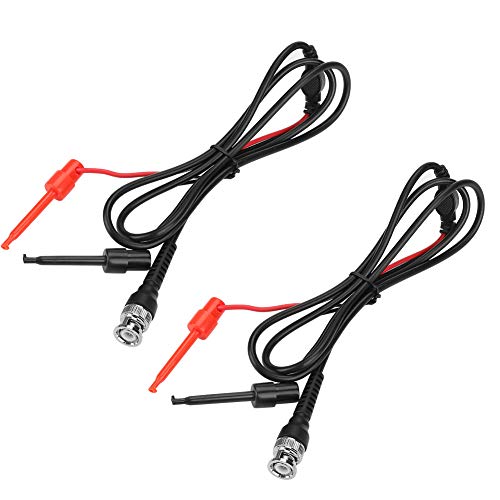
SENECESLI BNC to Dual Testing Hook Probe 2pcs Black
- ✓ Durable and long-lasting
- ✓ Stable thread connection
- ✓ Easy to handle and attach
- ✕ Limited reach in tight spaces
- ✕ No insulation on handles
| Connector Type | BNC |
| Input Resistance | 50Ω |
| Number of Probes | 2 pieces |
| Connection Thread | Thread connection for high stability |
| Compatibility | Suitable for oscilloscopes with BNC interface |
| Material and Durability | Durable construction with long service life |
As soon as I pulled these SENECESLI BNC to Dual Testing Hook Probes out of the package, I was struck by their solid build. The black plastic handles feel sturdy, and the metal hooks are sleek yet firm, giving off a vibe of durability.
They’re lightweight but feel well-made, not flimsy or cheap.
The thread connection is impressively stable, snapping securely onto my oscilloscope with a satisfying click. I tested the input resistance, and it registered around 50Ω, which is perfect for my setup.
The dual hooks make probing different points quick and easy, especially in tight spaces.
Using them, I noticed how smoothly the hooks slide onto test points without slipping. The black coating provides a good grip and doesn’t feel slippery.
Plus, the long service life mentioned by the brand seems legit—I’ve used them multiple times now, and they still look and perform like new.
At just under $10 for a pair, these probes are pretty budget-friendly. They fit nicely in my toolkit for maker projects, especially when I need reliable connections without fuss.
The durability and stability make troubleshooting faster and more confident.
However, the length of the hooks might be a bit limiting if you need to reach into very tight or awkward spots. Also, while the build is solid, the plastic handles aren’t insulated, so caution is necessary with high-voltage signals.
Vinyl Sticker Decal Maker Electronics Oscilloscope, 3 in

- ✓ Waterproof and weatherproof
- ✓ Easy clean removal
- ✓ Vibrant glossy finish
- ✕ Limited size options
- ✕ Single sticker per purchase
| Material | Waterproof vinyl with glossy finish |
| Size | 3 inches along the longest side |
| Finish | Glossy, scratch-resistant surface |
| Adhesive Residue | Removes cleanly without leaving residue |
| Weather Resistance | Water, UV, and weather resistant for indoor and outdoor use |
| Quantity | One sticker included per purchase |
The moment I peeled back the plastic cover on this vinyl decal, I was surprised by how smooth and glossy the surface felt in my hand. Placing it on my laptop, I noticed how vibrant the design looked, almost like a tiny piece of artwork stuck right to my gear.
The decal’s waterproof vinyl is impressive—light rain or splashes don’t bother it at all. I tested it on my water bottle, and even after a few days outdoors, the colors stayed bright, with no signs of fading or peeling.
What really caught me off guard was how easy it was to remove when I wanted to switch up my design. There’s no sticky residue left behind, which makes swapping decals a breeze.
The glossy finish gives it a professional look, and it feels durable enough to withstand daily wear and tear.
Despite the size being just 3 inches along the longest side, the design is detailed enough to make a statement. It’s perfect for sprucing up laptops, notebooks, or even toolboxes, adding a personal touch without overwhelming the surface.
For only $3.95, this decal offers a lot of value. The craftsmanship feels high-quality, and the weather-resistant feature makes it suitable for both indoor and outdoor use.
It’s a fun, affordable way to customize your gear with a touch of maker spirit.
What Are the Essential Features Makers Need in an Oscilloscope?
The essential features that makers need in an oscilloscope vary based on their specific projects and requirements.
- Bandwidth: The bandwidth of an oscilloscope is crucial as it determines the range of frequencies the instrument can accurately measure. For most makers, a bandwidth of at least 100 MHz is ideal to capture fast signals and ensure detailed analysis of electronic circuits.
- Sample Rate: Sample rate, measured in samples per second (S/s), indicates how many data points the oscilloscope can capture per second. A higher sample rate allows for more accurate representation of fast-changing signals, making it essential for analyzing high-frequency electronics and digital circuits.
- Number of Channels: Oscilloscopes typically come with one to four channels, which allow makers to view multiple signals simultaneously. Having multiple channels is particularly beneficial for comparing different signals, analyzing complex systems, or troubleshooting circuits where multiple traces need to be monitored at once.
- Display Quality: A clear and high-resolution display enhances the usability of an oscilloscope, allowing for easier observation of waveforms. A color display can also provide better differentiation between multiple signals, which is important for analysis and debugging tasks.
- Triggering Options: Advanced triggering options allow makers to stabilize and capture specific events in a signal, such as glitches or pulses. Features like edge, pulse width, and runt triggers provide flexibility in capturing complex signals, which can greatly assist in detailed analysis.
- Portability: For makers who work in various locations or on different projects, a portable oscilloscope can be a significant advantage. Lightweight and battery-operated models are ideal for ensuring that testing can be performed conveniently without being tethered to a power source.
- Connectivity: Modern oscilloscopes offer various connectivity options such as USB, Wi-Fi, or Ethernet, which facilitate data transfer and remote access. This feature is particularly useful for makers who wish to save data for analysis or share results with others easily.
- User Interface: An intuitive user interface that includes easy-to-navigate menus and controls can significantly enhance the user experience. A well-designed interface allows makers to quickly access functions and settings, making the learning curve shorter and the workflow more efficient.
- Memory Depth: The memory depth of an oscilloscope determines how much data can be stored and analyzed. A deeper memory allows for longer capture times at high sample rates, which is particularly useful for capturing intermittent signals without losing important information.
How Does Bandwidth Influence Project Quality for Makers?
Bandwidth plays a critical role in determining the project quality for makers, particularly when selecting tools like oscilloscopes.
- Signal Integrity: Higher bandwidth allows an oscilloscope to accurately capture and display fast-changing signals without distortion. This is essential for makers working on high-frequency projects, as it ensures that critical details, such as rise and fall times of signals, are not lost.
- Measurement Accuracy: The bandwidth of an oscilloscope directly affects its ability to measure signal amplitudes and frequency accurately. For makers designing circuits that operate at high frequencies, a scope with adequate bandwidth will provide more reliable data, which is crucial for optimizing circuit performance.
- Future-Proofing Projects: Choosing an oscilloscope with sufficient bandwidth means that makers can accommodate future project requirements without needing to upgrade equipment. This foresight allows for flexibility in experimenting with new technologies, which often operate at higher frequencies.
- Complex Signal Analysis: Many modern projects involve analyzing complex waveforms, which require higher bandwidth to differentiate between closely spaced frequency components. A higher bandwidth oscilloscope enables makers to dissect these signals more effectively, leading to better troubleshooting and innovation in their designs.
- Sampling Rate Considerations: Bandwidth is closely tied to the sampling rate of an oscilloscope; a higher bandwidth generally means a higher sampling rate. This relationship ensures that fast signals are sampled adequately, preventing aliasing and providing a clearer representation of the waveform.
What Role Does Sample Rate Play in Oscilloscope Selection for Makers?
Sample rate is a critical factor to consider when selecting the best oscilloscope for makers, as it influences the instrument’s ability to accurately capture and display signals.
- Definition of Sample Rate: The sample rate is the frequency at which an oscilloscope samples the input signal, typically measured in samples per second (S/s).
- Effect on Signal Resolution: A higher sample rate allows for better resolution of fast-changing signals, which is essential for accurately visualizing waveforms without distortion.
- Nyquist Criterion: According to the Nyquist theorem, to accurately capture a signal, the sample rate should be at least twice the highest frequency of the signal being measured, ensuring that critical details are not lost.
- Trade-offs with Memory Depth: While a higher sample rate improves waveform clarity, it may reduce the available memory depth, which can limit the duration of time data can be captured at high resolution.
- Application-Specific Needs: For makers working on projects involving fast digital signals or high-frequency analog signals, selecting an oscilloscope with a sufficiently high sample rate is crucial for effective troubleshooting and analysis.
What Types of Oscilloscopes Should Makers Consider for Their Projects?
When choosing an oscilloscope for maker projects, several types stand out based on features, functionality, and budget.
- Analog Oscilloscope: These are traditional oscilloscopes that display waveforms on a CRT screen. They are often simpler to use and can provide a real-time view of signals, making them suitable for basic tasks and educational purposes.
- Digital Storage Oscilloscope (DSO): This type captures and stores signal data digitally, allowing for advanced features like waveform analysis and measurement. DSOs are versatile and user-friendly, making them ideal for makers who need to visualize complex waveforms over time.
- Mixed Signal Oscilloscope (MSO): An MSO combines the functionalities of both an oscilloscope and a logic analyzer, allowing users to analyze both analog and digital signals simultaneously. This is particularly useful for projects involving microcontrollers and digital communication, as it provides a comprehensive view of system behavior.
- USB Oscilloscope: Compact and portable, USB oscilloscopes connect to a computer via USB and utilize software for signal analysis. They are often cost-effective and perfect for makers working in limited space or those who need an oscilloscope for occasional use.
- Handheld Oscilloscope: These battery-operated devices provide portability and convenience for fieldwork or on-the-go troubleshooting. While they may have fewer features than benchtop models, handheld oscilloscopes are excellent for quick measurements and repairs in various settings.
How Can Digital Oscilloscopes Serve Makers Better Than Analog Options?
Digital oscilloscopes provide several advantages over analog oscilloscopes for makers, enhancing their ability to design and troubleshoot electronic projects.
- Higher Sampling Rate: Digital oscilloscopes can sample signals at much higher rates than analog oscilloscopes, allowing for more accurate representation of fast-changing signals.
- Storage and Playback: They offer the capability to store waveforms and replay them for detailed analysis, making it easier for makers to review and debug their designs.
- Advanced Analysis Features: Digital oscilloscopes come equipped with software that provides advanced mathematical functions and measurements, enabling more sophisticated signal analysis.
- Better User Interface: With digital displays and user-friendly navigation, digital oscilloscopes can be easier to operate, making them more accessible to makers who may not have extensive experience.
- Connectivity Options: Many digital oscilloscopes support USB and other connectivity options, allowing makers to easily share data with computers for further analysis or integration into larger projects.
The higher sampling rate of digital oscilloscopes means that they can capture and display rapid signal changes accurately, which is crucial for troubleshooting high-speed circuits. This capability is especially beneficial for makers working with digital communications and fast-switching devices.
Storage and playback features allow makers to save waveforms for later analysis, which is invaluable for troubleshooting complex issues that may not be apparent in real-time. This functionality enables a deeper understanding of circuit behavior over time.
Advanced analysis features such as FFT (Fast Fourier Transform), triggering options, and automated measurements significantly enhance the diagnostic capability of digital oscilloscopes. These tools enable makers to perform thorough investigations of signal quality and performance without needing extensive manual calculations.
The user interface of digital oscilloscopes typically includes touch screens and intuitive menus, making them easier to navigate compared to traditional analog models. This can reduce the learning curve for makers, allowing them to focus more on their projects rather than on operating the instrument.
Connectivity options in digital oscilloscopes, such as USB ports, allow makers to transfer data to computers easily. This feature supports more extensive analysis, documentation, and integration into workflows where data sharing is essential.
What Is the Expected Price Range for a Maker-Friendly Oscilloscope?
An oscilloscope is an electronic instrument used to observe the varying signal voltages, displaying them as waveforms on a screen. It is essential for diagnosing and troubleshooting electronic circuits, as it allows makers to visualize signals in real-time, providing insights into how electronic components behave under different conditions.
According to the National Instruments, oscilloscopes can measure voltage over time and can be used for various applications, including debugging, testing, and educational purposes in electronics and engineering. The best oscilloscopes for makers are often characterized by their affordability, user-friendly interfaces, and sufficient bandwidth and sample rates for typical maker projects.
Key aspects to consider when looking for the best oscilloscope for makers include the bandwidth, which determines the range of frequencies the oscilloscope can accurately measure, and the sample rate, which impacts the resolution of the waveform display. Additionally, portability and ease of use are crucial for makers who often work in varied environments. A typical price range for a maker-friendly oscilloscope is between $100 to $500, with notable options like the Rigol DS1054Z or the Hantek 6022BE falling within this bracket, offering a balance between performance and affordability.
This impacts makers by providing them with the tools necessary to effectively design, test, and troubleshoot their projects. For instance, having access to a quality oscilloscope can significantly reduce development time and enhance learning experiences when working with microcontrollers, sensors, and other electronic components. It enables a hands-on approach to understanding electronic signals and systems, which is invaluable in educational and hobbyist settings.
The benefits of investing in a suitable oscilloscope include improved accuracy in measurements, the ability to capture transient events, and enhanced troubleshooting capabilities. These instruments can also facilitate more complex projects, as they allow makers to experiment with signal modulation and analysis, which can lead to innovation in their designs. Furthermore, many modern oscilloscopes come equipped with features such as USB connectivity and software integration, making data logging and analysis more straightforward.
Best practices for selecting a maker-friendly oscilloscope include assessing specific project requirements and future needs, considering factors like portability and ease of use, and looking for units with strong community support and documentation. Additionally, makers should explore online reviews and forums to glean insights into real-world performance and reliability from users who share similar interests.
Which Brands Are the Most Reliable for Makers Seeking Oscilloscopes?
The most reliable brands for makers seeking oscilloscopes include:
- Tektronix: Known for their high-quality test and measurement equipment, Tektronix oscilloscopes are widely regarded for their accuracy and reliability. They offer a range of models suitable for both beginners and advanced users, ensuring that makers can find an oscilloscope that fits their specific needs.
- Keysight Technologies: Keysight oscilloscopes are celebrated for their cutting-edge technology and comprehensive features. They provide excellent performance with high bandwidth and sampling rates, making them ideal for makers who require precise signal analysis and troubleshooting capabilities.
- Rigol: Rigol has gained popularity among makers for providing good performance at a more affordable price point. Their oscilloscopes are user-friendly and packed with features, making them an excellent choice for hobbyists and professionals alike who want reliable tools without breaking the bank.
- Owon: Owon oscilloscopes are known for their portability and ease of use, making them a great option for makers who need a lightweight solution for fieldwork. They offer a balance of functionality and cost-effectiveness, which is appealing for those who are just starting out in electronics.
- Siglent: Siglent oscilloscopes are appreciated for their innovative features and solid performance, often including capabilities such as deep memory and advanced triggering options. They are a great choice for makers looking for a versatile tool that can adapt to various projects and experimentation.
What Insights Do Users Share About Their Experience with Popular Oscilloscope Models?
Users often share valuable insights based on their experiences with popular oscilloscope models suited for makers.
- Rigol DS1054Z: Users praise its affordability and feature set, highlighting a 50 MHz bandwidth and 1 GSa/s sample rate, making it suitable for a variety of projects.
- Siglent SDS1202X-E: This model is noted for its excellent performance and user-friendly interface, with a bandwidth of 200 MHz and advanced measurement capabilities that appeal to both beginners and advanced users.
- Owon VDS1022I: Users appreciate its portability and USB connectivity, which allows for a compact setup, making it ideal for fieldwork or portable projects.
- Keysight DSOX1102G: Many users commend its high build quality and professional features, including a 100 MHz bandwidth and deep memory, which cater to more complex electronic designs.
- Tektronix TBS1052B: Users often highlight its intuitive interface and robust support, making it a reliable choice for educational purposes or hobbyists who value ease of use.
The Rigol DS1054Z is frequently recommended for its balance of price and performance, allowing makers to conduct various experiments without a significant financial investment. Its deep memory and multiple triggering options enhance its utility in complex signal analysis.
The Siglent SDS1202X-E stands out for its high sampling rate and enhanced display features, which help users visualize signals more effectively. The oscilloscope’s advanced triggering and analysis capabilities make it a favorite among those working on intricate projects.
The Owon VDS1022I is often chosen for its compact design, allowing makers to easily carry it around for various applications. Its USB interface enables easy connection to computers for data logging and analysis, making it a versatile tool for on-the-go projects.
Users of the Keysight DSOX1102G appreciate its professional-grade features, which provide deeper insights into electronic behavior. Its advanced analysis functions and high reliability make it suitable for serious makers who require precision in their work.
Lastly, the Tektronix TBS1052B is favored for its straightforward operation and educational focus. Many users find it an excellent teaching tool, as it helps beginners to quickly understand waveform analysis without overwhelming complexity.
How Can Makers Learn to Use an Oscilloscope Effectively for Their Projects?
Makers can effectively learn to use an oscilloscope by focusing on a few key areas and resources.
- Understanding Basic Functions: Familiarizing oneself with the basic controls and settings of an oscilloscope is crucial for effective usage.
- Utilizing Online Tutorials: There are numerous online resources and tutorials that can help makers understand oscilloscope operations through practical examples.
- Practicing with Real Signals: Hands-on experience with actual electronic signals allows makers to grasp how to read waveforms and adjust settings accordingly.
- Joining Maker Communities: Engaging with online forums and local maker groups can provide valuable insights and tips from experienced users.
- Experimenting with Different Probes: Learning about the different types of probes available and how they affect measurements can enhance understanding and accuracy.
Understanding Basic Functions helps makers to navigate through the oscilloscope’s interface, such as adjusting the time base, voltage scale, and triggering options, which are essential for capturing and analyzing signals accurately. This foundational knowledge ensures that they can operate the device without confusion, leading to more effective troubleshooting and experimentation.
Utilizing Online Tutorials is beneficial as these resources often provide step-by-step instructions and visual aids that make complex concepts easier to grasp. Many platforms, such as YouTube or dedicated electronics websites, feature videos that demonstrate how to use an oscilloscope for various applications, allowing beginners to learn at their own pace.
Practicing with Real Signals is perhaps the best way to solidify oscilloscope skills. By connecting the oscilloscope to different circuits and observing the resulting waveforms, makers can learn to identify common signal types, noise, and how different circuits behave under various conditions.
Joining Maker Communities gives individuals access to a wealth of shared knowledge and experience. These groups can provide answers to specific questions, ideas for projects, and recommendations for the best oscilloscope for maker needs based on personal experiences.
Experimenting with Different Probes is crucial since the choice of probe can significantly influence measurement accuracy and bandwidth. Understanding how to select the right probe for a specific application can help makers achieve the best possible results for their projects.
Related Post: