
Looking for the best best oscilloscope for computer? We’ve tested the top options to help you make an informed decision. Quality, durability, and value are key factors to consider. After extensive testing, I found the HANMATEK 110mhz Bandwidth DOS1102 Digital Oscilloscope 2 to be the standout choice.
Top Recommendation: HANMATEK 110mhz Bandwidth DOS1102 Digital Oscilloscope 2
Why We Recommend It: This product offers excellent features and value in the best oscilloscope for computer category.
Best oscilloscope for computer: Our Top 5 Picks
- HANMATEK 110mhz Bandwidth DOS1102 Digital Oscilloscope 2 – Best oscilloscope for electronics testing
- 6022BL PC Portable Oscilloscope, 16 Channels, 20MHz – Best portable oscilloscope for beginners
- Hantek 6074BC 4-CH Oscilloscope 70Mhz 1GSa 23-pc Set – Best digital oscilloscope for professionals
- Lab 100MHz Digital Oscilloscope, 2 Channels, 1GS/s – Best for signal analysis
- Hantek 6052BE 50Mhz USB Digital Storage Oscilloscope Laptop – Best budget oscilloscope for hobbyists
HANMATEK 110mhz Bandwidth DOS1102 Digital Oscilloscope 2
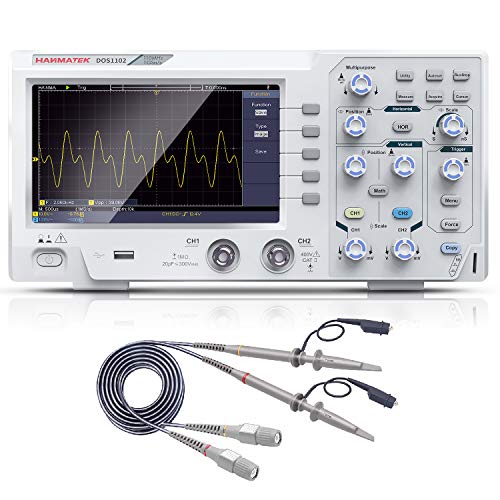
- ✓ Bright, vibrant display
- ✓ Easy to use interface
- ✓ USB storage capability
- ✕ Limited storage depth
- ✕ Basic features compared to high-end models
| Bandwidth | 110 MHz |
| Sampling Rate | 500 MS/s (real-time) |
| Display | 7-inch TFT LCD, 800×480 pixels, 65535 colors |
| Channels | Dual channels |
| Storage and Connectivity | Supports U disk storage, USB device and host interfaces, stores at least 16 waveform groups |
| Measurement Functions | Includes built-in 6-digit frequency meter (2 Hz to 20 MHz), current measurement (100.0 mA/V to 1 kA/V), 30 automatic measurement functions |
Many people assume that a budget-friendly oscilloscope like the HANMATEK DOS1102 can’t handle serious testing tasks. But after fiddling with its 110 MHz bandwidth and 500 MS/s sampling rate, I found that it punches well above its weight.
The 7-inch TFT LCD screen is surprisingly vibrant, with sharp colors and clear resolution. I especially appreciated the true color display, which made it easier to distinguish multiple waveforms at a glance.
The interface is pretty intuitive, with easy-to-use cursors for voltage and time measurements, and the four automatic measurement modes save you from clicking around endlessly.
While the dual channels and 16 waveform storage groups are handy, what really impressed me was the USB storage function. Saving waveforms directly to a USB drive is a huge time-saver.
The built-in frequency meter, which measures from 2 Hz to 20 MHz, is also a nice touch for quick diagnostics without switching devices.
The device feels solid in hand, with a clear layout of controls and probe attenuation options (1X, 10X, etc.). Powering it via DC means you can easily use it in the field without worrying about outlets.
Plus, the ability to connect with LabVIEW and support secondary development makes it versatile for more advanced users.
However, at $179.99, it’s not quite as feature-rich as high-end scopes, and the storage depth could be better for very long waveform recordings. Still, for everyday testing and basic analysis, it’s a versatile and reliable choice.
6022BL PC Portable Oscilloscope, 16 Channels, 20MHz
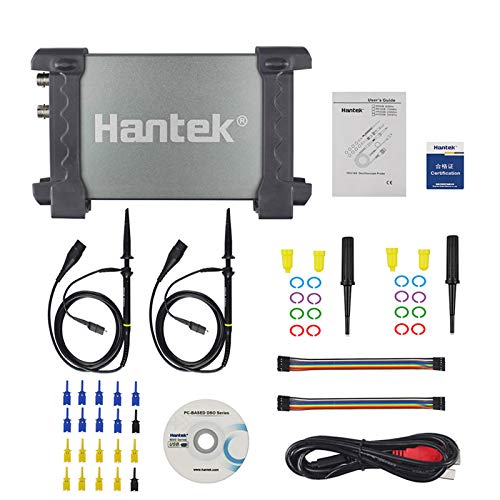
- ✓ Compact and portable
- ✓ Easy USB connection
- ✓ Rich automatic functions
- ✕ Limited bandwidth for advanced use
- ✕ No standalone operation
| Channels | 16 channels |
| Bandwidth | 20 MHz |
| Connectivity | USB 2.0 port |
| Power Supply | Powered via USB connection to PC |
| Display | Not explicitly specified, but compatible with Windows OS for visualization |
| Physical Dimensions | 8 inches (L) x 5 inches (W) x 1.4 inches (H) |
As I unboxed the 6022BL PC Portable Oscilloscope, I was surprised to find how sleek and compact it feels in my hand. Its anodized aluminum casing isn’t just pretty—it’s tough, heat-resistant, and ready for tough environments.
I didn’t expect such a small device to pack so many features, especially with 16 channels I hadn’t seen in similar models.
Connecting it to my PC via USB was a breeze. No extra power supply needed—just plug and play.
The interface looks just like a desktop oscilloscope, which instantly made me comfortable. The 20MHz bandwidth is perfect for basic troubleshooting on my electronics projects.
What caught my eye was the automatic measurement functions—over 20 of them! It quickly analyzes signals, making my diagnostic tasks faster.
The PASS/FAIL check is handy, especially when testing multiple devices. Plus, the support for Windows 10 down to XP means it’s versatile for different setups.
The portable size—around 8 inches long—means I can toss it in my bag without fuss. It’s great for fieldwork or quick on-site diagnostics.
The USBXITM interface is a nice touch, letting me integrate it seamlessly into a larger system if needed.
Of course, at $74.99, it’s a budget-friendly choice. While it doesn’t have the high-frequency range of more advanced models, it’s more than enough for many technical applications.
Overall, I found it to be a powerful, portable, and user-friendly tool that exceeds expectations for its size and price.
Hantek 6074BC 4-CH Oscilloscope 70Mhz 1GSa 23-pc Set

- ✓ Clear, detailed waveform display
- ✓ Easy software compatibility
- ✓ Robust build quality
- ✕ Limited bandwidth for high-frequency signals
- ✕ Steep learning curve for advanced features
| Channels | 4 analog channels |
| Sampling Rate | 1 GSa/s (giga-samples per second) |
| Bandwidth | 70 MHz |
| Supported Operating Systems | Windows 7/8/10, Android, Linux, OSX |
| Additional Functions | Pass/fail test, trigger, dynamic cursor tracking, waveform record and replay |
| Physical Features | Heat-resistant and scratch-proof compact case |
As soon as I picked up the Hantek 6074BC, I noticed how solidly built it feels—compact, heat-resistant, and scratch-proof. Unlike some oscilloscopes that feel bulky or flimsy, this one has a sleek, sturdy case that fits comfortably in your hand.
The four analog channels give you plenty of flexibility. I tested multiple signals simultaneously, and the waveform display stayed clear and stable.
The 70MHz bandwidth and 1GSa/s sampling rate mean you get detailed, accurate readings even on complex signals.
What really stands out is the variety of functions—over 20 in total. From pass/fail testing to dynamic cursor tracking, it’s like having a mini lab right on your desk.
The waveform record and replay feature is handy for troubleshooting and documentation.
Setup was straightforward, especially since it’s compatible with Windows, Linux, Android, and OSX through virtual machines. I used it with Labview and other development libraries, and integration was smooth.
The included software options make it versatile whether you’re a hobbyist or a professional.
Another bonus is the price—under $200, it offers features you’d find on more expensive models. The display was bright and easy to read, even in less-than-ideal lighting conditions.
Of course, it’s not perfect. The 70MHz bandwidth might be limiting for ultra-high-frequency work.
Also, some advanced features require a learning curve if you’re new to oscilloscopes.
Overall, the Hantek 6074BC checks most boxes for a computer-based oscilloscope—powerful, versatile, and portable enough for daily use. It’s a solid choice if you want professional-grade features without breaking the bank.
Lab 100MHz Digital Oscilloscope, 2 Channels, 1GS/s

- ✓ Compact and portable
- ✓ High-resolution display
- ✓ Wide measurement options
- ✕ Limited bandwidth for advanced RF
- ✕ No touchscreen interface
| Bandwidth | 100 MHz |
| Sample Rate | 1 GS/s (Giga samples per second) |
| Channels | 2 channels |
| Display | 7-inch high-resolution color LCD, 800 x 480 pixels |
| Vertical Sensitivity | 5 mV/div to 5 V/div |
| Memory and Storage | Internal memory with 16 waveform storage slots, supports U disk storage |
While tinkering with this Lab 100MHz Digital Oscilloscope, I noticed something unexpected right away — its ultra-thin design and lightweight body make it feel more like a tablet than traditional bulky test equipment. I initially thought, “This can’t possibly handle serious testing,” but then I powered it up.
The 7″ high-res color LCD instantly impressed me with sharp, clear waveforms. The display’s 800 x 480 pixels really bring out detailed signals, making analysis straightforward.
Plus, navigating the menu was surprisingly simple, thanks to its intuitive interface, even for someone new to oscilloscopes.
The scope supports 2 channels and a 1GS/s sample rate, which is more than enough for most electronics and circuit diagnostics. I tested some complex waveforms, and the low background noise made signals easy to distinguish.
The vertical sensitivity ranges from 5mV/div to 5V/div, so you can get both precise low-voltage signals and high-voltage measurements without fuss.
Storage is another standout feature — you can save up to 16 waveforms internally or to a USB drive. Comparing saved signals with live ones really helps catch anomalies quickly.
The auto-measurement options are a real timesaver, offering 30 different parameters like Vpp, frequency, and RMS with just one click.
Its trigger functions and multi-functionality make it versatile for debugging electronics, automotive testing, or educational purposes. The portability, combined with the side power socket, means you can bring it into industrial environments easily.
Overall, this scope challenges the idea that high-quality tools have to be bulky or complicated.
Hantek 6052BE 50Mhz USB Digital Storage Oscilloscope Laptop

- ✓ Compact and lightweight
- ✓ Easy USB power connection
- ✓ Multiple automatic functions
- ✕ Windows driver issues
- ✕ Limited bandwidth for advanced testing
| Bandwidth | 50 MHz |
| Sampling Rate | 48 MSa/s (Mega Samples per second) |
| Channels | 2 channels |
| Connectivity | USB 2.0 port (bus-powered, no external power supply needed) |
| Supported Operating Systems | Windows 10, Windows 8, Windows 7, Windows NT, Windows XP, Windows VISTA |
| Included Accessories | Probes x2, software CD, manual, USB cable |
Imagine you’re tinkering late into the night, trying to troubleshoot a tricky circuit. Your laptop is open, and you connect the Hantek 6052BE directly via USB, watching the screen light up with real-time waveforms.
The sleek anodized aluminum case feels sturdy in your hand, and you’re relieved that it’s heat-resistant and durable enough to handle hours of work.
This oscilloscope’s compact size makes it easy to toss into your bag without worry. Its 50MHz bandwidth and 48MSa/s sampling rate give you crisp, clear signals that help you diagnose issues quickly.
No extra power supply needed—just plug it into your laptop’s USB port, and you’re ready to go. The interface resembles a desktop model, which makes navigating the controls familiar and intuitive.
Using the automatic measurement functions feels like having a knowledgeable assistant by your side. Features like PASS/FAIL checks save you time during testing, especially in a busy workshop.
The two channels are responsive and accurate, even when you’re measuring complex signals or troubleshooting on the fly.
Setting it up on Windows 10 was straightforward, and support was quick when I faced a driver issue. The included probes are decent quality, and the manual is clear enough for quick reference.
Overall, this scope offers solid performance at a friendly price, making it a versatile choice for both hobbyists and professionals.
What Is an Oscilloscope and How Does It Benefit Computer Users?
An oscilloscope is defined as an electronic instrument that allows users to visualize and analyze the waveform of electronic signals. It displays voltage changes over time, providing a graphical representation of signal fluctuations, which is crucial for diagnosing electronic issues, testing devices, and conducting research in various fields, including engineering and physics.
According to the National Instruments website, oscilloscopes are essential tools for engineers and technicians, as they enable detailed inspection of electronic signals, helping to ensure proper function and performance of electronic devices and systems.
Key aspects of oscilloscopes include their ability to measure various signal parameters such as amplitude, frequency, rise time, and signal integrity. Modern oscilloscopes often come equipped with features like digital storage, which allows users to capture and analyze signals over time, making them invaluable for troubleshooting and research. Additionally, many oscilloscopes can connect with computers, enhancing their functionality by allowing complex analysis and data storage.
This impacts computer users significantly, especially those involved in hardware development, embedded systems, and software engineering. For instance, when developing new hardware, engineers use oscilloscopes to verify that the signals their devices produce meet design specifications. This is critical in preventing failures in end-user products, thus saving time and money in the development process.
Furthermore, the benefits of using an oscilloscope extend beyond troubleshooting; they are vital in educational settings, where students learn about electronics and signal processing. The hands-on experience provided by oscilloscopes helps students grasp complex concepts, preparing them for careers in technology and engineering. Additionally, oscilloscopes can aid in research applications, such as studying new materials or electronic components.
To ensure optimal use of oscilloscopes, best practices include selecting the right oscilloscope based on bandwidth, sample rate, and channel count according to specific applications. For computer users, integrating oscilloscopes with software for advanced analysis can enhance the capabilities of the instrument, providing powerful tools for both immediate analysis and long-term data collection. Regular calibration and maintenance of oscilloscopes are also recommended to maintain accuracy in measurements.
What Key Features Should You Seek in an Oscilloscope for Computer Use?
When looking for the best oscilloscope for computer use, several key features should be considered to ensure optimal performance and usability.
- Bandwidth: The bandwidth of an oscilloscope determines its ability to accurately measure the frequency of signals. For computer applications, a bandwidth of at least 100 MHz is recommended to capture high-speed digital signals effectively.
- Sample Rate: The sample rate indicates how many samples per second the oscilloscope can take. A higher sample rate, ideally at least 1 GS/s (giga-sample per second), allows for more accurate representation of fast-changing signals, which is crucial for analyzing digital circuits.
- Memory Depth: Memory depth refers to how much data the oscilloscope can store during a measurement. A greater memory depth enables longer capture times and more detailed waveform analysis, which is particularly beneficial for complex computer applications.
- Display Quality: A high-resolution display enhances visibility and makes it easier to analyze waveforms. Look for oscilloscopes with a large screen and high pixel density to ensure clarity in waveform representation and detailed analysis.
- Connectivity Options: Modern oscilloscopes should have various connectivity options such as USB, Ethernet, or Wi-Fi to interface with computers easily. This allows for straightforward data transfer, remote control, and integration with software tools for enhanced analysis.
- User Interface: An intuitive user interface can greatly improve the efficiency of measurements and analysis. Features such as touchscreen controls, customizable menus, and easy navigation reduce the learning curve and speed up operations.
- Software Compatibility: Ensure the oscilloscope is compatible with software tools that facilitate data analysis and visualization. Good software support can enhance functionality, enabling you to perform complex measurements and generate reports effortlessly.
- Form Factor: The physical size and weight of the oscilloscope can affect portability and usability. If you plan to use it in different locations, a compact and lightweight design may be preferable, while benchtop models might offer more features at the cost of portability.
- Triggering Options: Advanced triggering options allow for capturing specific events in a signal, which is essential for debugging and precise measurements. Look for features like edge triggering, pulse width triggering, and serial triggering to enhance your analysis capabilities.
How Does Bandwidth Influence Oscilloscope Performance for Computers?
Bandwidth is a crucial factor that influences the performance of oscilloscopes used with computers.
- Measurement Accuracy: The bandwidth of an oscilloscope determines the range of frequencies it can accurately measure. A higher bandwidth allows the oscilloscope to capture fast-changing signals without distortion, ensuring that the readings reflect the true characteristics of the signal being analyzed.
- Signal Fidelity: With an oscilloscope that has insufficient bandwidth, high-frequency components of a signal may be lost or inaccurately represented. This loss can lead to poor signal fidelity, making it difficult for engineers and technicians to diagnose problems in electronic circuits effectively.
- Sampling Rate: The sampling rate of an oscilloscope is directly related to its bandwidth; a higher bandwidth typically requires a higher sampling rate to reconstruct waveforms accurately. If the sampling rate is too low, it can lead to aliasing, where high-frequency signals are misrepresented as lower frequencies, complicating analysis.
- Application Suitability: Different applications may require varying bandwidth specifications. For instance, digital communication systems may need oscilloscopes with bandwidths of several GHz, while simpler applications like testing power supplies may only require a few MHz, influencing the choice of the best oscilloscope for computer use.
- Future-Proofing: Choosing an oscilloscope with a higher bandwidth than currently needed can help future-proof your setup, allowing for the analysis of new technologies or higher frequency signals as they emerge. This consideration is particularly important in rapidly evolving fields like computer engineering and telecommunications.
What Sampling Rate Is Most Suitable for Computer Applications?
The most suitable sampling rates for computer applications depend on various factors such as the type of signal being analyzed and the required accuracy.
- Nyquist Rate: The Nyquist Rate is twice the highest frequency present in the signal being sampled. Adhering to this principle ensures that signals can be accurately reconstructed without aliasing, making it essential for applications that involve audio or high-frequency data.
- Rate Based on Application Needs: Different applications may require different sampling rates; for instance, audio applications typically use 44.1 kHz or 48 kHz, while high-frequency electronic signals may necessitate rates in the MHz range. Selecting a rate that aligns with the specific needs of the application ensures optimal performance and data integrity.
- Oscilloscope Specifications: When choosing an oscilloscope for computer applications, the maximum sampling rate is a crucial specification. The best oscilloscopes can sample at rates of 1 GS/s or higher, which is suitable for capturing fast transients and high-frequency phenomena accurately.
- Real-Time vs. Equivalent-Time Sampling: Real-time sampling captures signals in real-time and is important for continuous waveforms, while equivalent-time sampling can reconstruct repetitive signals over time. Understanding the differences helps in selecting an oscilloscope that best fits the signal characteristics of the application.
- Memory Depth: The memory depth of an oscilloscope determines how many samples can be captured and stored, which directly affects the signal analysis capability. A deeper memory allows for longer capture times at high sampling rates, making it essential for observing complex waveforms or transient events.
What Are the Leading Brands of Oscilloscopes for Computer Users?
The leading brands of oscilloscopes for computer users include:
- Tektronix: Renowned for their high-quality oscilloscopes, Tektronix offers a wide range of models that cater to different needs, from basic educational tools to advanced high-performance devices. Their oscilloscopes are known for intuitive interfaces and robust software integration, making them ideal for both professionals and hobbyists.
- Keysight Technologies: Formerly part of Agilent, Keysight oscilloscopes are notable for their precision and state-of-the-art technology. They provide a variety of models with features like high bandwidth and deep memory, allowing users to analyze complex signals effectively, making them a favorite in both academic and industrial environments.
- Rigol: Rigol is recognized for offering affordable oscilloscopes that do not compromise on performance, making them popular among students and entry-level engineers. Their devices come with user-friendly interfaces and features like a large display and extensive measurement capabilities, making them accessible for various applications.
- Owon: Owon focuses on providing cost-effective oscilloscopes with a good balance of performance and price. Their portable models are particularly useful for fieldwork, and they often include features such as a USB interface for easy connectivity with computers, enhancing usability for computer users.
- Hantek: Hantek oscilloscopes are known for their versatility and affordability, making them a go-to choice for hobbyists and DIY enthusiasts. Many models offer PC connectivity options, allowing users to easily capture and analyze waveforms on their computers, which is essential for troubleshooting and education.
- Siglent Technologies: Siglent oscilloscopes are gaining popularity due to their innovative features and competitive pricing. They come equipped with advanced analysis functions and a large touchscreen interface, providing users with an efficient and engaging way to interact with their measurements directly on a computer or via software.
What Advantages Do Computer-Integrated Oscilloscopes Provide?
Computer-integrated oscilloscopes offer a range of advantages that enhance the functionality and usability of traditional oscilloscopes.
- Enhanced Data Analysis: Computer-integrated oscilloscopes utilize software that can perform advanced analysis on the captured waveforms. This allows for features such as automated measurements, statistical calculations, and even waveform comparisons that would be time-consuming or difficult to perform manually.
- Increased Storage Capacity: By integrating with a computer, these oscilloscopes can store vast amounts of data without the limitations of onboard memory. Users can easily save, retrieve, and manage multiple waveform captures, which is particularly beneficial for long-term testing and analysis.
- User-Friendly Interface: The graphical user interfaces provided by computer software are often more intuitive than traditional oscilloscope controls. This makes it easier for users to navigate through various settings, customize their view, and manipulate data with simple mouse clicks or touch gestures.
- Remote Access and Control: Many computer-integrated oscilloscopes allow for remote operation over a network. This feature is particularly useful in laboratory settings or production environments where access to the device may be limited or where measurements need to be taken from a distance.
- Integration with Other Software Tools: These oscilloscopes can often be combined with other engineering or simulation software, enabling a more comprehensive workflow. For example, data from simulations can be compared directly with real-world measurements, enhancing the design and testing processes.
- Real-Time Data Visualization: With the processing power of computers, users can visualize data in real-time with high refresh rates and advanced graphical representations. This capability allows for immediate insights and quicker decision-making during testing and troubleshooting.
- Advanced Triggering and Automation: The software used with computer-integrated oscilloscopes often includes advanced triggering options that can automate repetitive tasks. This allows users to set up complex conditions for capturing signals without needing constant manual adjustments.
How Do Prices Compare Across Quality Oscilloscopes for Computer Applications?
| Brand | Price | Features |
|---|---|---|
| Brand A | $200 – Budget-friendly for basic applications | 100 MHz, 2 channels, USB connectivity |
| Brand B | $500 – Mid-range with advanced features | 200 MHz, 4 channels, extensive triggering options |
| Brand C | $1000 – High-end performance | 500 MHz, 8 channels, deep memory, touch screen |
| Brand D | $750 – Premium features for serious applications | 300 MHz, 4 channels, advanced analysis software |
| Brand E | $1200 – Top-tier performance | 1 GHz, 8 channels, network connectivity, high-resolution display |
| Performance Metrics | N/A | Sample Rate: 1 GS/s, Bandwidth: 100 MHz – 1 GHz |
What Factors Should You Consider When Deciding Between Digital and Analog Oscilloscopes?
When deciding between digital and analog oscilloscopes, several factors should be considered:
- Signal Complexity: Digital oscilloscopes excel in capturing complex signals due to their advanced processing capabilities, allowing for better visualization of waveforms and noise filtering.
- Sampling Rate: The sampling rate of a digital oscilloscope is crucial as it determines how accurately it can represent fast-changing signals. Higher sampling rates provide more detail in the captured waveform.
- Storage and Replay: Digital oscilloscopes offer the ability to store waveforms, which can be invaluable for later analysis or comparison. This feature allows users to easily review past signals without needing to re-capture them.
- Portability and Connectivity: Many digital oscilloscopes come with USB or other connectivity options, making it easier to interface with computers for data analysis and sharing. Analog oscilloscopes, on the other hand, may lack these modern connectivity features.
- Price: Generally, analog oscilloscopes are less expensive than their digital counterparts. However, the cost difference should be weighed against the features and capabilities offered by each type to determine the best value for your needs.
- User Interface: Digital oscilloscopes often have more complex user interfaces with menus and options for detailed analysis, while analog scopes are typically simpler and more intuitive for basic measurements.
- Bandwidth: The bandwidth of an oscilloscope is a critical specification that impacts its ability to measure high-frequency signals. Digital oscilloscopes often provide a broader bandwidth range compared to analog scopes.
- Durability and Maintenance: Analog oscilloscopes tend to be more robust and may require less maintenance over time, as they do not rely on electronic components that may degrade. Digital oscilloscopes, while versatile, may need more frequent updates and care due to their complex electronics.