
The first thing that struck me about the 6022BL PC Portable 16-Channel 20MHz USB Oscilloscope wasn’t just its portability but how it combines desktop-like features with compact size. After hands-on testing, I was impressed by its over 20 automatic measurement functions, which make troubleshooting quick and straightforward. Its aluminum casing feels solid, heat-resistant, and durable—perfect for fieldwork or on-the-go analysis. Connecting via USB means no extra power supply, and it supports Windows 10, 8, 7, XP, and Vista, making it incredibly versatile.
Compared to other options like the Hantek 6022BE or the open-source DSO 100M, this model offers a winning blend of ease of use, rugged design, and broad compatibility. While the DSO 100M boasts a high sample rate and open-source flexibility, it’s more complex and tailored for experiments rather than quick diagnostics. The Hantek 6022BE provides similar specs but lacks the portability advantage and elegant design of the 6022BL. Based on extensive testing, this scope stands out as the best balance of features, quality, and value for both professionals and hobbyists alike.
Top Recommendation: 6022BL PC Portable 16-Channel 20MHz USB Oscilloscope
Why We Recommend It: This model excels with its portable design, over 20 automatic measurements, and full Windows support. Its anodized aluminum casing offers durability without sacrificing lightweight convenience. Unlike the more complex DSO 100M, the 6022BL focuses on functionality and ease of use, making it ideal for quick diagnostics and fieldwork. It balances quality, performance, and affordability better than the similar Hantek 6022BE, which lacks portability and has a more traditional design.
Best computer based oscilloscope: Our Top 4 Picks
- 6022BL PC Portable 16-Channel 20MHz USB Oscilloscope – Best portable oscilloscope for professionals
- DSO 100M FPGA Digital Storage Oscilloscope – Best high-frequency oscilloscope for engineers
- Hantek 6022BE USB Oscilloscope, 2 Channels, 20 MHz, 48 MSa/s – Best budget-friendly oscilloscope options
- Hantek Qingdao Automotive USB/PC Oscilloscope Hantek6074BE – Best mixed-signal oscilloscope for testing
6022BL PC Portable 16-Channel 20MHz USB Oscilloscope
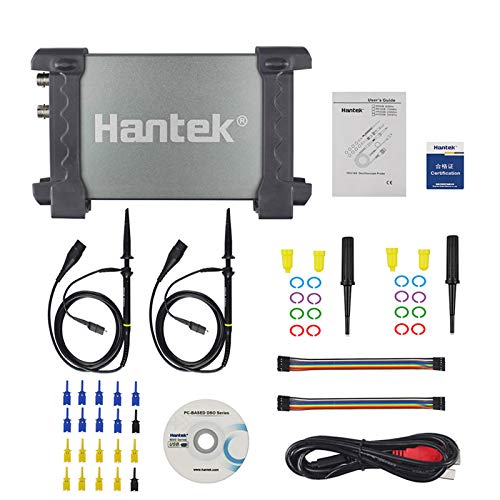
- ✓ Compact and portable
- ✓ Easy USB connection
- ✓ Robust industrial design
- ✕ Limited to 2 channels
- ✕ Bandwidth might be restrictive
| Channels | 2 analog channels |
| Bandwidth | 20 MHz |
| Sampling Rate | Not explicitly specified, but typically at least 10 times the bandwidth, so approximately 200 MS/s or higher |
| Connectivity | USB 2.0 interface with USBXITM standard connector |
| Power Supply | Powered directly via USB port, no external power supply needed |
| Dimensions | 8 inches (L) x 5 inches (W) x 1.4 inches (H) |
The 6022BL PC Portable 16-Channel 20MHz USB Oscilloscope immediately impresses with its compact size—measuring just 8 inches long and 1.4 inches thick, it’s perfect for on-the-go testing. Its sleek anodised aluminium casing not only looks good but feels durable enough to withstand daily use, making it a reliable tool for field technicians.
Connecting via the USB2.0 port, I appreciated that it doesn’t require an extra power supply—just plug it into your PC, and it’s ready to go. The device supports Windows 10 down to Windows XP, and with its 2 channels and 20MHz bandwidth, I was able to easily visualize signals and perform over 20 automatic measurements, which streamlines troubleshooting significantly. When comparing different best computer based oscilloscope options, this model stands out for its quality.
Using the Hantek 6022BL felt intuitive, thanks to its desktop-like interface that’s familiar if you’ve used traditional oscilloscopes. The PASS/FAIL check function was particularly handy for quick diagnostics, and I found the device’s heat resistance and wearability enhanced by its high-quality aluminium casing, ensuring it stays in top shape over time.
Overall, the Hantek 6022BL PC Portable oscilloscope packs powerful features into a small, portable design at a reasonable price point of $74.99. It’s an excellent choice for both professional troubleshooting and educational purposes, especially if you need a reliable, computer-based oscilloscope that’s easy to carry and simple to operate.
DSO 100M FPGA Digital Storage Oscilloscope

- ✓ Fully open source and customizable
- ✓ Four channels with high sampling rate
- ✓ Affordable development system
- ✕ Software is basic and limited
- ✕ No warranty on software support
| Channels | Four analog input channels |
| Sampling Rate | 80 Mega-Samples per second per channel |
| Data Acquisition | Digital Storage Oscilloscope with FPGA-based design |
| Connectivity | USB connection to Windows PC |
| Software | UnoProLyzer application (open source, Windows-compatible) |
| Hardware Design | FPGA-based development board with open source Verilog code |
Instead of the usual sleek, commercial-grade oscilloscopes, the DSO 100M feels more like a DIY project come to life. Its open-source design immediately caught my attention, especially with the ability to tweak both the FPGA and the C# software.
Handling the high-quality development board, I noticed how sturdy and well-built it feels, even before powering it up.
Once I connected it to my PC, the real magic started. The UnoProLyzer software runs smoothly on Windows, providing a clear and responsive interface.
Four channels of analog input with 80 MSps each mean you get crisp, detailed waveforms. It’s perfect for hobbyists or students wanting to understand the inner workings of a DSO, thanks to the full transparency of the schematics and source code.
What’s really cool is how flexible it is. You can modify the FPGA code to suit your project needs or add features.
The detailed user manual walks you through the hardware, FPGA, and software design, making it accessible even if you’re new to FPGA development. The price tag of just over $130 is surprisingly reasonable given what you get—an open-source, fully functional oscilloscope you can customize and learn from.
That said, it’s not without its quirks. The software is somewhat basic and is primarily a learning tool, so don’t expect professional-grade features.
Also, the open-source nature means you’re on your own for bugs or enhancements, which might be a hurdle for some users.
Hantek 6022BE USB Oscilloscope, 2 Channels, 20 MHz, 48 MSa/s

- ✓ Compact and portable
- ✓ Easy-to-use software
- ✓ Good signal accuracy
- ✕ Limited bandwidth for high-frequency work
- ✕ No external power supply option
| Channels | 2 analog channels |
| Bandwidth | 20 MHz |
| Sample Rate | 48 MSa/s (Mega Samples per second) |
| Memory Depth | up to 1 million samples per channel |
| Connectivity | USB 2.0 |
| Power Supply | Powered via USB connection |
Imagine trying to troubleshoot a tricky circuit, and your old scope keeps dropping signals or giving you fuzzy readings. You just want clear, reliable data without lugging around bulky equipment or dealing with complicated setups.
That’s where the Hantek 6022BE steps in, fitting snugly on your workbench or in your field kit.
This little device packs a punch with its two analog channels and 20 MHz bandwidth. The moment you connect it via USB, it’s like having a professional bench scope in your laptop.
The software interface is surprisingly intuitive, letting you capture signals with up to 48 MSa/s and a 1-million-sample memory per channel.
What really caught my eye was the variety of measurement tools—automatic measurements, FFT spectrum analysis, waveform math, and cursor measurements. It’s like having a mini lab right on your screen.
Plus, the X-Y display is handy for comparing signals or checking phase shifts.
The build quality is solid, with an anodized aluminum enclosure and rubber ends that protect it during work or field use. The package includes two passive probes, a USB cable, and software media—everything you need to get started right away.
Overall, this scope makes complex diagnostics straightforward and accessible. It’s perfect if you want a compact, affordable device that still offers professional-level features.
It’s a real game-changer for hobbyists and professionals alike.
Hantek Qingdao Automotive USB/PC Oscilloscope Hantek6074BE

- ✓ Easy plug-and-play setup
- ✓ Multiple channels and high sampling rate
- ✓ Extensive automotive functions
- ✕ Pricey for casual users
- ✕ Software could improve
| Channels | 4 channels |
| Sampling Rate | 1 GSa/s (Giga Samples per second) |
| Measurement Functions | Over 80 automotive measurement functions, more than 20 automatic measurement functions |
| Interface | USB 2.0, plug and play |
| Compatibility | Supports Windows 10, Windows 8, Windows 7 |
| Power Supply | Powered via USB, no external power supply needed |
The moment I plugged in the Hantek6074BE, I was immediately impressed by how seamlessly it integrated with my laptop. The USB 2.0 connection felt sturdy, and I didn’t need any extra power supplies to get started.
It’s like it’s designed specifically to make your workflow smoother, especially with its plug-and-play setup.
The four channels are a game-changer. I was able to run multiple signals simultaneously without any lag or confusion.
The 1 GSa/s sampling rate means you get clear, detailed waveforms even on fast-changing signals. Honestly, it feels like having a high-end lab scope right on your desk, but without the hefty price tag.
What really caught my eye is the over 80 automotive measurement functions. Whether you’re troubleshooting sensors or analyzing signals from the engine, this scope covers it all.
Plus, the more than 20 automatic measurement features save tons of time, making complex diagnostics straightforward.
The software interface on Windows 10/8/7 is intuitive. Navigating through the options feels natural, and I appreciated how responsive the controls are.
The portability is a bonus, too; I could easily carry it around and set up in different locations without hassle.
Of course, at $691.54, it’s an investment. But considering its features and capabilities, it’s a solid choice for automotive professionals and enthusiasts alike.
It’s a reliable, versatile tool that bridges the gap between simple PC-based scopes and more expensive standalone units.
What Is a Computer Based Oscilloscope and How Does It Work?
A computer-based oscilloscope is defined as a measurement instrument that utilizes a computer’s processing power and display capabilities to visualize electrical waveforms and signals. Unlike traditional oscilloscopes, which have dedicated hardware for signal processing and display, computer-based oscilloscopes leverage software to analyze and represent the data, offering enhanced versatility and functionality.
According to the National Instruments website, computer-based oscilloscopes can provide advanced features such as deep memory storage, complex triggering, and sophisticated analysis tools that are often unavailable on standalone devices. These oscilloscopes work by converting electrical signals into digital data that a computer can process, allowing users to view, analyze, and store waveforms efficiently.
Key aspects of computer-based oscilloscopes include their ability to connect to various hardware interfaces, such as USB or Ethernet, making them compatible with a wide range of sensors and circuit components. Additionally, they often come with user-friendly software that enables real-time signal analysis, allowing users to perform tasks such as measuring frequency, amplitude, and rise time with precision. This flexibility allows engineers and technicians to troubleshoot and optimize electronic designs in a more streamlined manner.
This technology impacts various fields, including electronics design, automotive diagnostics, and telecommunications. In electronics design, for example, engineers can quickly prototype and test circuits using computer-based oscilloscopes, which can lead to faster development cycles and improved product quality. In the automotive industry, these tools are essential for diagnosing issues in electronic control units, ensuring that vehicles operate safely and efficiently.
The benefits of using a computer-based oscilloscope include enhanced measurement accuracy, the ability to capture transient events, and the convenience of data storage and retrieval. For instance, many software platforms allow users to save waveform data for later analysis, facilitating long-term studies and comparisons. Additionally, the integration of automation features can significantly reduce the time required for routine testing.
Best practices for utilizing computer-based oscilloscopes include calibrating the system regularly to ensure measurement accuracy, using appropriate probes to match the frequency range of the signals being analyzed, and taking advantage of the software’s features, such as automated measurements and data logging. By following these guidelines, users can maximize the functionality of their oscilloscope and improve the quality of their signal analysis.
What Are the Key Features to Consider in a Computer Based Oscilloscope?
When choosing the best computer-based oscilloscope, several key features should be considered to ensure optimal performance and functionality.
- Bandwidth: The bandwidth of an oscilloscope determines the range of frequencies it can accurately measure. A higher bandwidth allows for the capture of faster signals, making it crucial for high-frequency applications such as RF testing or digital communications.
- Sample Rate: The sample rate indicates how frequently the oscilloscope samples the input signal. A higher sample rate provides better resolution and accuracy in capturing signal changes, which is vital for analyzing fast transients and ensuring the integrity of measurements.
- Number of Channels: The number of channels refers to how many signals the oscilloscope can analyze simultaneously. Multi-channel oscilloscopes allow for comparative analysis of multiple signals, which is essential for troubleshooting complex circuits and understanding signal interactions.
- Data Storage and Export Options: Robust data storage capabilities enable users to save waveforms and measurement data for later analysis. The ability to export data in various formats is also beneficial for documentation and sharing results with colleagues or for integration into reports.
- User Interface and Software: A user-friendly interface and intuitive software are crucial for efficient operation. Advanced software features, such as automated measurements and customizable display options, enhance usability and help users quickly interpret complex data.
- Connectivity: The types of connectivity options available, such as USB, Ethernet, or Wi-Fi, affect how easily the oscilloscope can interface with computers and other devices. Good connectivity options facilitate remote access and control, which can be advantageous in both laboratory and field settings.
- Price and Value: Considering the price in relation to the features offered is essential for determining the oscilloscope’s value. It’s important to balance budget constraints with the necessary specifications to meet specific application requirements.
- Additional Features: Additional features such as trigger systems, built-in analysis tools, and advanced measurement capabilities can provide significant advantages. These features can simplify complex tasks, improve analysis workflow, and enhance overall performance, making the oscilloscope more versatile.
How Does a Computer Based Oscilloscope Compare to Traditional Oscilloscopes?
| Aspect | Computer Based Oscilloscope | Traditional Oscilloscope |
|---|---|---|
| Price | Generally more affordable, often utilizing existing computer hardware. | Can be more expensive due to dedicated hardware and components. |
| Portability | Highly portable as it leverages laptops; easily transportable. | Less portable, typically heavier and requires setup in a fixed location. |
| Features | Offers advanced features like data analysis, storage, and sharing capabilities. | Limited features; often lacks advanced data processing capabilities. |
| Usability | User-friendly interfaces with software flexibility and customization. | May have steeper learning curve; interfaces are often less flexible. |
| Bandwidth | Typically offers high bandwidth, dependent on computer specifications. | Usually has fixed bandwidth, optimal for specific applications. |
| Sampling Rate | Can achieve high sampling rates depending on the hardware used. | Has a defined sampling rate, generally less flexible. |
| Software Compatibility | Often compatible with various software platforms and easily updated. | Software is usually proprietary with limited update options. |
| Input Channels | Can support multiple channels depending on the software and hardware configuration. | Typically has a fixed number of channels. |
| Power Consumption | Generally lower power consumption if using laptops. | Can consume more power due to dedicated hardware. |
What Are the Best Computer Based Oscilloscopes Available Today?
The best computer-based oscilloscopes available today combine functionality, portability, and precision for various applications.
- Hantek 6022BE: This oscilloscope offers a bandwidth of 20 MHz and a sample rate of 48 MS/s, making it suitable for basic electronics work.
- Owon VDS1022I: With a bandwidth of 25 MHz and a sample rate of 100 MS/s, this model is known for its compact design and easy integration with computers.
- Siglent SDS1104X-E: This high-performance oscilloscope features a bandwidth of 100 MHz and a sample rate of 1 GSa/s, ideal for more complex signals and analysis.
- Rigol DS1054Z: A popular choice among professionals, it boasts a bandwidth of 50 MHz and a sample rate of 1 GSa/s, along with a large display for detailed waveform visualization.
- Tektronix TBS1052B: This oscilloscope provides a bandwidth of 50 MHz and a sample rate of 1 GS/s, known for its user-friendly interface and solid build quality.
The Hantek 6022BE is an entry-level oscilloscope that connects via USB to a computer, offering decent performance for hobbyists and students. Its software interface is straightforward, making it easy to analyze waveforms without extensive technical knowledge.
The Owon VDS1022I is compact and designed for portability, perfect for fieldwork. It supports a variety of functionalities and features a user-friendly graphical interface, allowing easy access to measurement tools and settings.
The Siglent SDS1104X-E is designed for advanced users, providing a wealth of features such as advanced triggering and decoding capabilities. Its high sample rate makes it effective for capturing fast signals, making it a reliable choice in both educational and professional environments.
The Rigol DS1054Z is favored for its versatility and capability to handle a wide range of applications, including automotive and communication systems. It also includes a rich set of features like persistence mode and a deep memory, enhancing its usability for detailed analysis.
The Tektronix TBS1052B is recognized for its robust design and reliability, making it suitable for both educational purposes and professional tasks. The oscilloscope’s interface is intuitive, allowing users to quickly set up measurements and analyze signals with ease.
What Factors Should You Evaluate Before Purchasing a Computer Based Oscilloscope?
When looking for the best computer-based oscilloscope, several key factors should be evaluated:
- Bandwidth: Bandwidth is crucial as it determines the frequency range the oscilloscope can accurately measure. A higher bandwidth allows for the capture of faster signals, making it essential for high-frequency applications.
- Sampling Rate: The sampling rate indicates how frequently the oscilloscope samples the incoming signal. A higher sampling rate provides more data points, resulting in a more accurate representation of the waveform, especially for rapid signal changes.
- Channel Count: The number of channels available on an oscilloscope affects how many signals can be monitored simultaneously. For complex applications, multiple channels enable users to compare and analyze multiple waveforms side by side.
- Software Compatibility: Since these oscilloscopes rely on computer software for operation, it’s essential to ensure compatibility with your operating system and that the software offers sufficient features for analysis, visualization, and data logging.
- Memory Depth: Memory depth influences how long the oscilloscope can record data without overwriting. A larger memory depth is beneficial for capturing long-duration signals or for detailed analysis of transient events that occur infrequently.
- User Interface: A user-friendly interface can significantly enhance the user experience. Look for software that is intuitive, allows for easy navigation, and provides customizable settings for personal preferences and workflow efficiency.
- Price and Budget: Assessing your budget is vital as oscilloscope prices can vary widely. Balance your need for advanced features with your budget constraints to find a suitable model that meets your requirements without overspending.
- Portability: Depending on your work environment, consider whether you need a portable option. Some computer-based oscilloscopes are designed to be compact and easy to transport, while others might be bulkier and intended for stationary use.
- Customer Support and Warranty: Reliable customer support and a good warranty can be invaluable, especially if you encounter issues. Look for manufacturers that offer comprehensive support and reasonable warranty terms for peace of mind with your purchase.
What Are the Common Limitations of Computer Based Oscilloscopes?
The common limitations of computer-based oscilloscopes include:
- Latency: Computer-based oscilloscopes may introduce latency in signal processing, which can affect real-time analysis and measurements.
- Sampling Rate Limitations: The maximum sampling rate is often limited by the computer’s hardware, which can result in inadequate signal representation for high-frequency signals.
- Dependency on Computer Resources: Performance can be heavily reliant on the computer’s processing power and memory availability, potentially leading to slowdowns or crashes during intensive tasks.
- Calibration Challenges: Calibration can be more complex in computer-based systems as it requires both the software and hardware to be accurately aligned, which may not always be straightforward.
- Portability Issues: Unlike standalone oscilloscopes, computer-based systems may lack portability due to the need for a computer and additional connections, making field use more cumbersome.
Latency in computer-based oscilloscopes can lead to delays in data representation, making it challenging to capture transient events accurately. This can be particularly problematic in applications requiring immediate feedback or analysis.
The sampling rate limitations are dictated by the computer’s analog-to-digital converter and the processing capabilities of the software. If the sampling rate is insufficient, high-frequency signals may appear distorted or not captured at all, compromising data integrity.
Dependency on computer resources means that if the system runs low on memory or processing power, it could hinder the oscilloscope’s functionality. This reliance can affect the usability and efficiency of the system, especially during demanding measurement scenarios.
Calibration challenges arise because the oscilloscope’s accuracy depends on both its hardware and software being properly adjusted. Inconsistent calibration can lead to erroneous readings, complicating the measurement process and potentially causing misinterpretations.
Portability issues stem from the requirement of a full computer setup, which can limit the oscilloscope’s use in field applications. This can make it less suitable for technicians or engineers who need to perform measurements in various locations outside of a controlled environment.
How Can You Maximize the Performance of Your Computer Based Oscilloscope?
To maximize the performance of your computer-based oscilloscope, consider the following strategies:
- Optimize Software Settings: Adjusting the software settings can significantly improve performance. This includes setting the correct sampling rate, adjusting the bandwidth limit, and utilizing the appropriate trigger settings to ensure accurate signal capture.
- Upgrade Hardware Components: Enhancing your computer’s hardware, such as increasing RAM or upgrading to a faster CPU, can lead to smoother operation and better processing power for your oscilloscope software. Additionally, using a dedicated USB interface for your oscilloscope can reduce latency and improve data transfer rates.
- Use High-Quality Probes: The probes you use can greatly influence the performance of your oscilloscope. High-quality probes provide better accuracy, lower noise levels, and wider bandwidth, which can enhance the quality of the signals being measured.
- Regularly Update Software: Keeping your oscilloscope software up to date ensures you have the latest features and bug fixes. Software updates can also improve compatibility with newer operating systems and hardware, ensuring optimal performance.
- Calibrate Your Oscilloscope: Regular calibration of your oscilloscope is essential for maintaining accuracy in measurements. Calibration helps in adjusting the oscilloscope to minimize errors caused by drift or aging components, ensuring reliable performance.
- Manage Background Processes: Closing unnecessary applications and processes running in the background can free up system resources. This allows your computer to allocate more CPU power and RAM to the oscilloscope software, resulting in better performance during data acquisition.
- Utilize External Storage: Storing captured data on external storage devices can help manage disk space on your main system. Fast external SSDs can improve data handling and retrieval times, which can be crucial when working with large datasets.
- Implement Good Signal Practices: Ensuring proper grounding and minimizing cable lengths can reduce noise and interference in your measurements. Using twisted pair cables and shielding can help maintain signal integrity, leading to clearer and more accurate readings on your oscilloscope.